Ranking
#7

Ranking
#7
Followers
443 M
Digital presence
Official profiles, streaming and discovery.
What a good fan recites by heart (or pretends to).
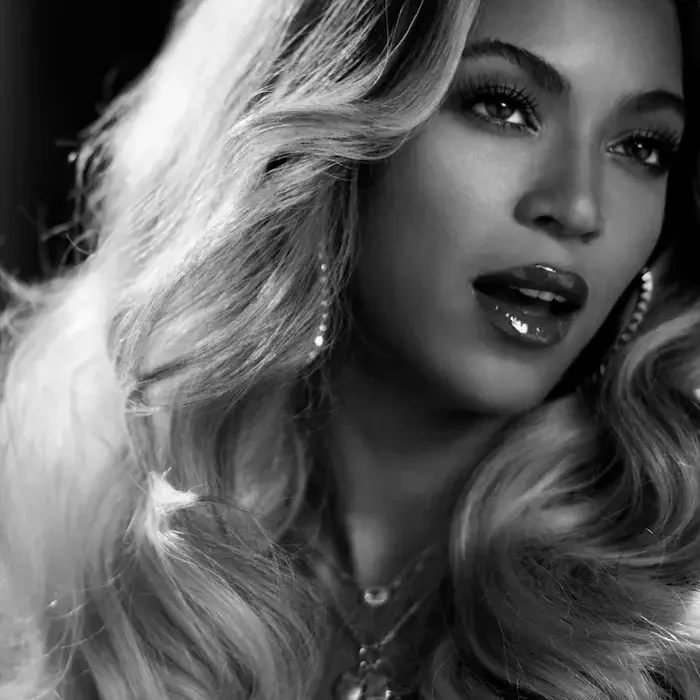
Beyoncé is not best understood simply as a singer with a powerful voice. She is better understood as an artist who turned pop into a complete discipline: music, body, image, archive, choreography, history, control, spectacle and cultural memory. Some figures dominate an era with songs; Beyoncé has done something more complex. She has built eras in which every detail seems to answer to a larger vision. Her career does not move only from album to album, but from language to language. First came the young prodigy from Houston, then the central voice of Destiny’s Child, then the solo artist who helped redefine 2000s R&B, the performer who raised the standard for global stages, the visual author of her own mythology and, more recently, an artist determined to revisit Black musical history inside genres the industry has often tried to separate.
Beyoncé Giselle Knowles was born in Houston, Texas, and that Texas origin has become more meaningful with time. Before the stadiums, Grammys and visual albums, there were rehearsals, competitions, girl groups and an almost military training in singing, dancing and stage presence. Destiny’s Child was her first major public school. With Kelly Rowland and Michelle Williams, the group took late-1990s and early-2000s pop-R&B into a place of vocal precision, female independence and perfectly engineered hooks. Songs like “Say My Name,” “Bills, Bills, Bills,” “Survivor” and “Independent Women” already carried part of the DNA that would later define Beyoncé: control of harmony, narratives of strength, competitive elegance and the idea that vulnerability could live beside authority.
Her solo breakthrough with Dangerously in Love was not just a departure from the group. It was a statement of scale. “Crazy in Love” did not merely introduce Beyoncé as an individual artist; it launched her into pop with horns, movement and charisma that still feel like one of the defining openings of a 21st-century solo career. From there, her figure expanded quickly. B’Day showed a fiercer, more physical, more rhythmic energy, with “Déjà Vu” and “Irreplaceable” standing at opposite poles: the body in motion and the breakup line that becomes a public verdict. I Am... Sasha Fierce turned that duality into an explicit concept: the emotional balladeer and the unleashed performer, “Halo” and “Single Ladies” as two sides of the same ambition.
But Beyoncé became harder to categorize with 4. That album was not just a bridge; it was a statement of taste: R&B, soul, funk, adult pop, vocals shaped with nearly artisanal patience. “Love on Top” looked backward without sounding dated. “Run the World (Girls)” insisted on the power of the collective body. “Countdown” mixed joy, rhythm and pop architecture with rare freedom. By then, it was clear that Beyoncé was not only chasing hits. She was trying to control the formats in which hits could exist.
The self-titled Beyoncé album in 2013 changed the rules of presentation. Released without warning, with a video for every track, it turned the pop album into a visual event, a digital conversation and a complete experience. “Drunk in Love,” “Partition,” “XO” and “Flawless” revealed an adult artist: sensual, sharper, more politically alert and increasingly in possession of her own narrative. Lemonade took that idea to a higher level. It was album, film, confession, ritual, family archive and a conversation about race, gender, betrayal, Southern inheritance and resistance. “Formation” did not feel like an ordinary single. It felt like a position. Beyoncé was no longer simply making pop; she was using pop to organize symbols.
Her relationship with the stage also changed the standard. Homecoming, her 2018 Coachella document, was not just a concert film. It was a performance thesis on historically Black colleges and universities, marching bands, dance, excellence, discipline and African American memory. One of the central keys to Beyoncé is visible there: the appearance of perfection does not come from surface gloss alone, but from extreme physical and conceptual work. Every transition, breath, dancer formation and camera look seems designed to remind us that spectacle can also be a form of writing.
Renaissance opened another door: the dance floor as a space of Black and queer liberation. House, disco, ballroom, funk, electronic music and R&B merged into an album that did not ask permission to be pleasure, archive and celebration at once. “Break My Soul” arrived like an instruction to release the weight. “Cuff It” turned groove into a common language. The album as a whole worked like a meticulously researched party. It was not club nostalgia; it was lineage rebuilt through rhythm.
COWBOY CARTER expanded that project even further. Rather than “doing country” as costume, Beyoncé used country, blues, folk, gospel, rock, R&B and Americana to question who gets to tell the story of those sounds. “Texas Hold ’Em” was infectious and popular, but the album reached deeper: “16 Carriages,” “Blackbiird,” “Ya Ya,” “II Most Wanted” and “Amen” opened conversations about roots, exclusion, family, pride, archive and reinvention. Its Album of the Year win at the Grammys was not only a personal milestone; it also underlined that her recent project is not a genre excursion, but an argument about musical memory.
Beyoncé matters because she has turned excellence into an aesthetic and creative control into a form of freedom. Her music can live at a wedding, in a club, at a protest, in a stadium, in a dance class or in a bedroom where someone needs to remember who they are. Few artists have joined technical precision and popular emotion with such force. At her best, Beyoncé does not seem to follow pop culture. She seems to stop it, reorganize it and return it at a different scale.
Main genre
R&B
Main subgenres
Like a superfan's list — except verified, with sources and links.
13–Apr 15, 2018
Indio, California · United States
Past
13–Sep 22, 2013
Rio de Janeiro, Rio de Janeiro · Brazil
Past
04–Jul 07, 2013
New Orleans, Louisiana · United States
Past02–Jul 05, 2009
New Orleans, Louisiana · United States
Past05–Jul 08, 2007
New Orleans, Louisiana · United States
PastWhat we managed to link to the concert archive. If a date is missing, tell us — happens to us too.
No linked concerts
Every concert and festival of the year, traced on the globe. Hit play and follow the route stop by stop.
Photos from the public archive.
Recent coverage linked to the artist.


Close by genre and social signal.
No related artists
When there is enough genre signal, they will appear here.