Ranking
#17

Ranking
#17
Followers
272.9 M
Digital presence
Official profiles, streaming and discovery.
What a good fan recites by heart (or pretends to).
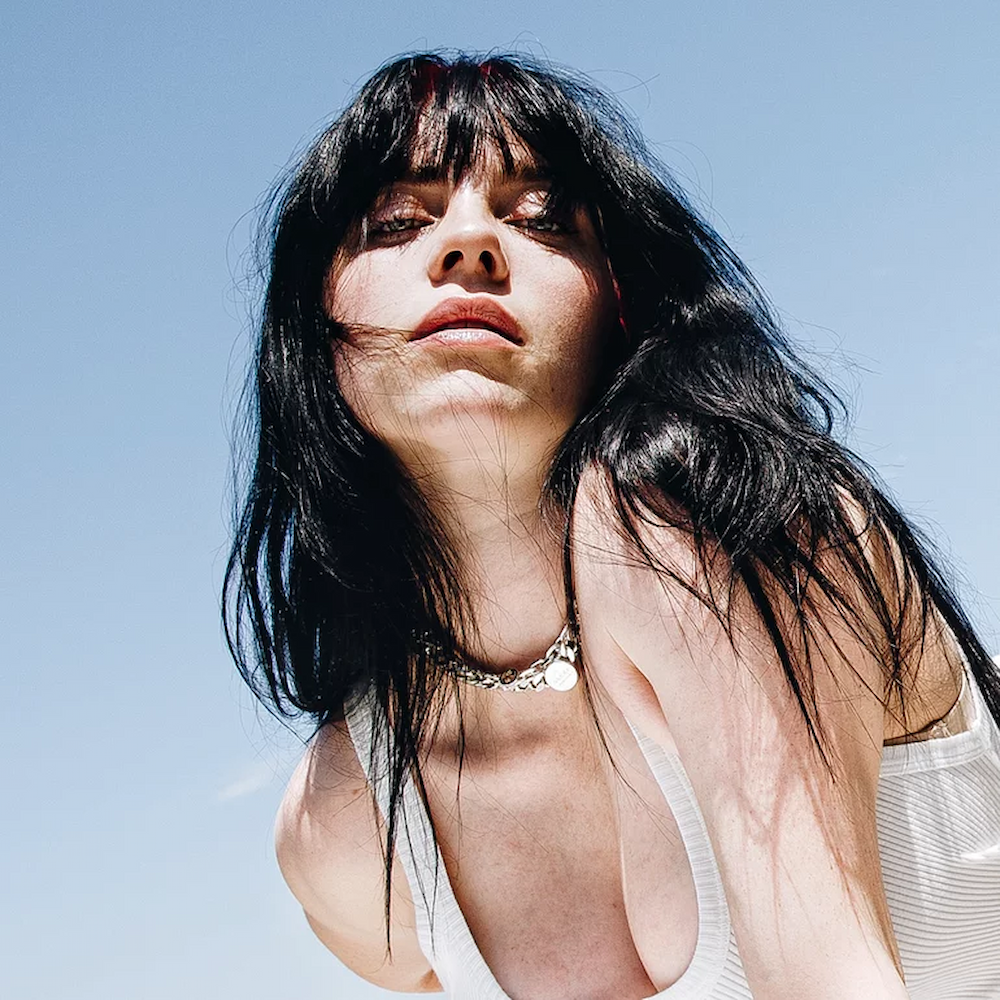
Billie Eilish’s revolution began almost quietly. She did not arrive with a diva-pop explosion, a stadium-ready choreography plan, or the classic idea of a teen star manufactured to smile in every photograph. She arrived as a strange whisper from a Los Angeles bedroom: a teenage voice, nearly ghostlike, floating over minimal production made with her brother. “Ocean Eyes” did not sound like a song designed to change pop, but it did something more dangerous: it opened a door. Suddenly, a generation used to noise found intensity in silence, drama in breath, and a new way to feel accompanied without anyone raising their voice.
Billie Eilish Pirate Baird O’Connell was born in Los Angeles, in a home where creativity was not a distant fantasy but part of daily life. Her parents were connected to the arts, her brother Finneas was making music, and she grew up outside a conventional school mold, with a creative freedom that would shape her identity. That context matters because Billie did not appear as the product of a standard pop academy. Her first major school was domestic: songs made at home, vocals recorded close to the microphone, ideas tested between siblings, videos, the internet, adolescent sensitivity and an instinctive refusal to resemble too closely what already existed.
Her bond with Finneas is one of the keys to her entire career. It is not simply a singer-producer relationship, but a kind of family laboratory where trust allows them to reach deeply intimate places. In her earliest songs, that intimacy is everywhere: the voice at the edge of the ear, small sounds, dark bass, empty spaces, choruses that do not try to explode so much as slip under the skin. Billie did not need to sing louder than everyone else. She made listeners lean in. That inversion changed a great deal of the pop that followed: music no longer had to sound gigantic to feel enormous.
dont smile at me introduced her as more than a viral promise. Songs like “Bellyache,” “idontwannabeyouanymore” and “when the party’s over” blended black humor, insecurity, guilt, teenage sadness and unsettling visual style. Billie did not sell a shiny, clean, aspirational adolescence. She presented an uncomfortable one, full of strange thoughts, difficult bodies, anxiety, irony, quiet rage and tenderness hidden behind a defiant stare. Her oversized clothes, extreme colors, way of looking into the camera and refusal to fit conventional pop femininity became part of her language, not as decoration, but as protection and statement.
When We All Fall Asleep, Where Do We Go? was the moment that language became global. The album sounded like a homemade pop nightmare: creaking doors, trembling bass, whispers, breaths, macabre humor, sweet melodies warped by dark production. “bad guy” was the perfect song to crack the mainstream because it was catchy and strange at the same time. It did not resemble the dominant maximal pop of the moment, but it had immediate personality. “bury a friend” sounded like it was being sung from under the bed. “you should see me in a crown” turned threat into teenage elegance. “when the party’s over” showed the opposite extreme, a nearly motionless fragility.
The album’s sweeping Grammy success was historic, but also strange. Billie became the symbol of a new generation before she was old enough to fully process what that meant. Suddenly, the artist who had built her power from the bedroom was standing at the center of the global music industry. That tension between intimacy and exposure has become one of the major lines in her work. Billie writes from small places, but lives inside a massive scale. Her music often seems to ask what remains of a person when millions are watching their clothes, body, voice, style changes, interviews and silences.
Happier Than Ever was a more adult and more bitter response. The album did not simply try to repeat the playful horror of her debut. It moved toward jazz, classic pop, balladry, spoken word, discomfort with power, abuse, fame, privacy and contained anger. “Your Power” was delicate but devastating. “Not My Responsibility” turned public judgment of her body into a spoken piece. “Happier Than Ever” exploded into rock catharsis after beginning almost like a soft confession. That song remains one of the clearest expressions of her growth: Billie no longer only whispered from fear; she could also scream from the edge.
“What Was I Made For?” expanded her cultural place even further. Written for Barbie, the song worked because it managed to say something enormous through minimal fragility: the question of purpose, identity, and the exhaustion of performing a version of oneself. It was not only a film ballad; it was a piece that connected with the contemporary feeling of being constructed, watched and sometimes hollow. Her second Oscar confirmed that Billie and Finneas had achieved something rare: turning commissioned songs into deeply personal work.
Hit Me Hard and Soft showed a Billie more confident in her complexity. “Lunch” opened a more physical and direct zone. “Chihiro” moved like a liquid dream. “Birds of a Feather” found a kind of emotional brightness that had been less common in her catalog. “Wildflower” brought guilt and desire into more mature writing. The album does not abandon intimacy, but expands it. There is more body, more movement, more texture, more vocal risk. Billie no longer seems only like the girl singing from the shadows; now she can move in and out of them with greater control.
Billie Eilish matters because she changed the relationship between youth, darkness and global pop. She made weirdness sound massive without making it stop feeling weird. She turned the bedroom into a stage, the whisper into an identity, anxiety into language and vulnerability into aesthetic strength. Her career is still early if measured by age, but her impact already belongs to an entire generation. At her best, Billie does not try to illuminate everything. She lets certain songs breathe in half-light, and that is exactly where many listeners find clarity.
Main genre
POP
Main subgenres
Like a superfan's list — except verified, with sources and links.
01–Sep 03, 2023
Country Laois · Ireland
Past
25–Aug 27, 2023
Reading · United Kingdom
Past
25–Aug 27, 2023
Leeds · United Kingdom
Past23–Aug 27, 2023
Saint-Cloud, Hauts-de-Seine · France
Past18–Aug 20, 2023
Biddinghuizen · Netherlands
Past
17–Aug 20, 2023
Hasselt, Limburg · Belgium
Past
10–Aug 15, 2023
Budapest · Hungary
Past04–Aug 06, 2023
Montreal, Quebec · Canada
Past
03–Aug 06, 2023
Chicago, Illinois · United States
Past
Mar 31 – Apr 02, 2023
Monterrey, Nuevo León · Mexico
PastWhat we managed to link to the concert archive. If a date is missing, tell us — happens to us too.
No linked concerts
Every concert and festival of the year, traced on the globe. Hit play and follow the route stop by stop.
Photos from the public archive.
Recent coverage linked to the artist.


Close by genre and social signal.
No related artists
When there is enough genre signal, they will appear here.