Ranking
#20

Ranking
#20
Followers
239.9 M
Digital presence
Official profiles, streaming and discovery.
What a good fan recites by heart (or pretends to).
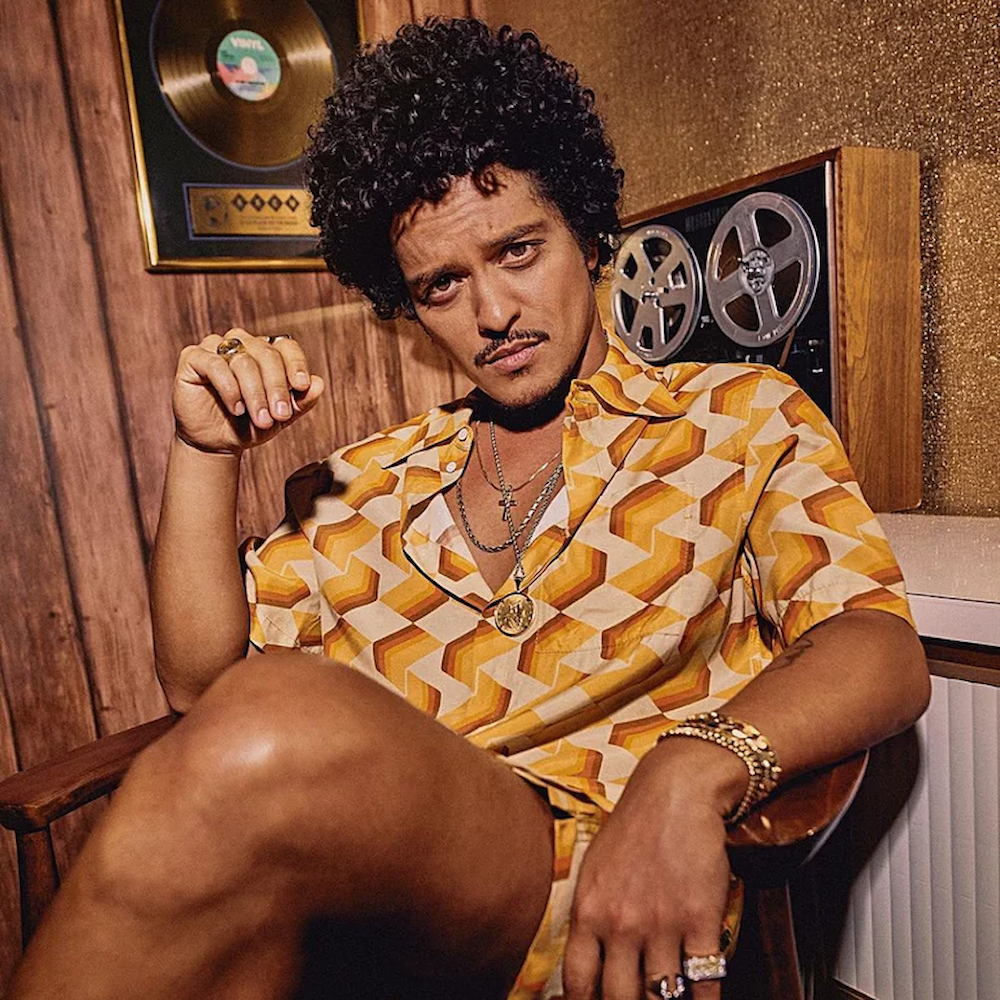
Bruno Mars has something that seems simple until someone tries to copy it: he makes popular music as if he still believes in the old craft of entertainment. He does not present himself as an artist obsessed with appearing unreachable, nor as a figure who needs to wrap every song in abstract mystery. His power sits somewhere else: in the stage, the perfectly cut suit, the flawless chorus, the bassline that smiles, the band that breathes with him, the voice that can move from sweetness to a shout without losing elegance. Bruno Mars understands pop as a party worked down to the millimeter, but also as an inherited tradition: doo-wop, soul, funk, reggae, R&B, disco, rock and roll, balladry and Vegas showmanship placed at the service of songs that want to be remembered by everyone.
Peter Gene Hernandez was born in Honolulu, Hawaii, inside a family where music was not a distant possibility but daily life. His father played percussion, his mother sang and danced hula, and Bruno grew up seeing entertainment as discipline, joy, family and work. The image of the child impersonating Elvis Presley at four is not only a charming anecdote; it is a central clue. From very early on, Bruno learned that singing was not enough. You had to enter the stage, look at the crowd, move, and make a song feel larger than the recording. That childhood training explains much of his adult career. Bruno Mars does not sing like someone who discovered the stage after the studio. He sings like someone raised by the stage before the industry knew what to do with him.
When he moved to Los Angeles, success did not arrive immediately. Before becoming a solo star, Bruno worked from the less visible side of pop: songwriting, production, arrangements, songs for other artists. With The Smeezingtons, alongside Philip Lawrence and Ari Levine, he began building a sound that looked backward without sounding old. “Nothin’ on You” with B.o.B and “Billionaire” with Travie McCoy were the first public warning: there was a voice there, smooth and clear, capable of turning a rap or pop song into something warm, melodic and universal. Bruno did not arrive as a star suddenly manufactured in public. He arrived as a craftsman who already understood the internal structure of a hit before putting his full name out front.
Doo-Wops & Hooligans turned him into the protagonist. “Just the Way You Are” arrived with almost classic simplicity: a direct ballad of admiration, free of cynicism, built for weddings, radio, dedications and teenage memories. “Grenade” pushed melodrama until it became almost theatrical. “The Lazy Song” showed his relaxed, humorous, beachy side. The album had the feel of a musical postcard: reggae-pop, light soul, ballads, modern doo-wop, open-hearted romance. At a time when much pop wanted to sound futuristic or electronic, Bruno chose another lane: songs built from familiar structures, performed with an impeccable voice and a stage charm that never apologized for itself.
Unorthodox Jukebox expanded the range. “Locked Out of Heaven” mixed rock energy, reggae and pop with a nearly physical urgency. “When I Was Your Man” was a bare piano ballad about regret and loss, with his voice carrying everything without needing decoration. “Treasure” looked toward funk and disco with carefully calculated retro precision. That album confirmed that Bruno was not only the romantic guy from “Just the Way You Are.” He was a musician with an encyclopedic memory of pop, able to jump between eras without losing his center. His work was not passive nostalgia, but recreation: taking familiar sounds and making them present, bright and useful for a new generation.
“Uptown Funk,” with Mark Ronson, crowned that ability. The song was not only a massive hit; it proved that funk could return to the center of global pop if performed with enough attitude, groove and showmanship. Bruno did not sound like a guest on the track. He sounded like its natural owner. Every shout, step, pause and gesture seemed designed to remind people that pop can also be body. After that, 24K Magic turned that energy into a full album. Bruno moved deep into ’90s R&B, luxury funk, new jack swing, gold-chain brightness and seductive comedy. “24K Magic,” “That’s What I Like” and “Finesse” were not chasing confessional depth. They were chasing pleasure, rhythm, charisma and total command of the dance floor.
With Silk Sonic, alongside Anderson .Paak, Bruno found an even more elegant way to play with tradition. An Evening with Silk Sonic was ’70s soul turned into velvet theater: smoke, suits, backing vocals, falsettos, soft drums, humor, seduction and an almost fetishistic obsession with detail. “Leave the Door Open” worked because it sounded old and new at once, affectionate parody and real song, wink and feeling. Silk Sonic made it clear that Bruno Mars does not only absorb influences. He knows how to build an entire world around them.
The recent era of “Die With a Smile,” “APT.” and The Romantic confirmed his staying power from another angle. After years without a solo album, Bruno did not return trying desperately to sound young. He returned to his own territory: romance, dance, soul, funk, Latin touches, warm production and a sense of showmanship few contemporary artists carry so naturally. “I Just Might” reinforced his ability to turn a playful melody into a global event, while “Risk It All” and the rest of the album showed an artist more comfortable than ever inside his own character: the elegant romantic, the band musician, the singer who knows a song can be sophisticated and popular at the same time.
Bruno Mars matters because he has defended a deeply musical idea of pop in an era often dominated by fast image and fragmented consumption. His work does not always try to reinvent the future; sometimes it does something just as difficult: reminding us why certain forms never stop working. A good bassline, a tuned voice, a real band, a romantic phrase, a dance step and a chorus that stays in memory. At his best, Bruno does not seem to chase trends. He seems to turn on the lights, call in the band and prove that showmanship, when made with craft, can still feel timeless.
Main genre
POP
Main subgenres
Like a superfan's list — except verified, with sources and links.
No linked festivals
No festival appearances documented yet.
What we managed to link to the concert archive. If a date is missing, tell us — happens to us too.
Philadelphia · United States
No salePhiladelphia · United States
Tickets →Bruno Mars - The Romantic Tour
Foxborough · United States
No saleFoxborough · United States
Tickets →Bruno Mars - The Romantic Tour
Indianapolis · United States
No saleTampa · United States
No saleTampa · United States
Tickets →Bruno Mars - The Romantic Tour
French Quarter
No saleMiami Gardens · United States
No saleMiami · United States
Tickets →Every concert and festival of the year, traced on the globe. Hit play and follow the route stop by stop.
Photos from the public archive.
Recent coverage linked to the artist.




Close by genre and social signal.
No related artists
When there is enough genre signal, they will appear here.