Ranking
#11

Ranking
#11
Followers
332.2 M
Digital presence
Official profiles, streaming and discovery.
What a good fan recites by heart (or pretends to).
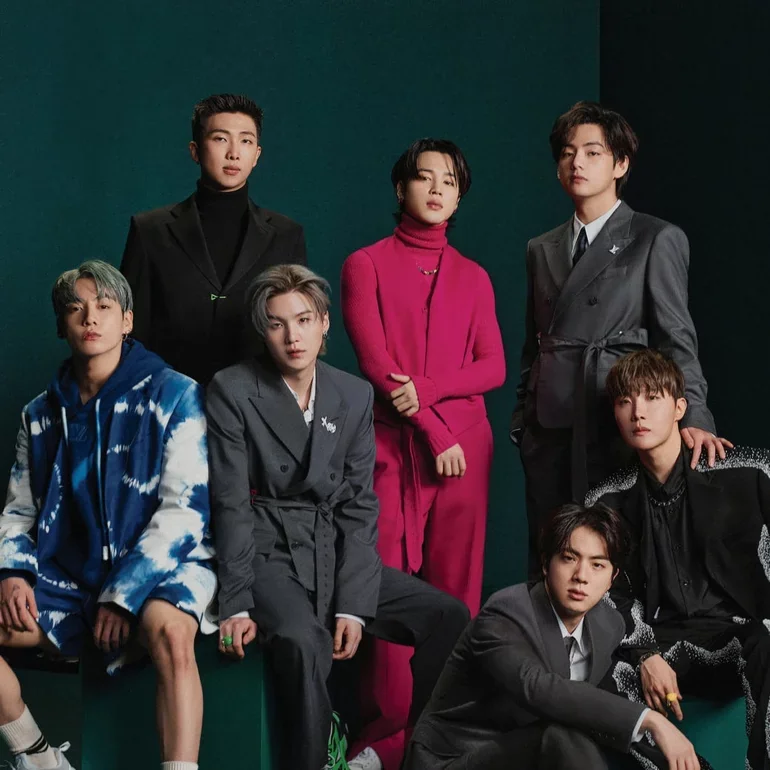
Before BTS became a name capable of filling stadiums in countries where many fans do not speak Korean, there were seven young men training at a small company, sharing rooms, rehearsing deep into the night and trying to find space inside an industry that did not seem built to bet on them. That early image matters because it explains much of their story. BTS did not begin as an obvious world-conquering machine. They began as an anomaly that grew through work, music, open cameras, vulnerable lyrics and a constant conversation with a fandom that eventually became part of the phenomenon itself.
Formed in Seoul under BIGHIT Music, BTS debuted in 2013 with an identity strongly marked by hip-hop. RM, Suga and J-Hope brought a rap-rooted foundation that set the group apart from many idol acts of their generation, while Jin, Jimin, V and Jung Kook completed a lineup capable of carrying melody, dance, image and emotional storytelling. In the beginning, their world sounded sharper, younger, more confrontational. Songs like “No More Dream” and “N.O” spoke about school pressure, social expectations and teenage frustration with a mix of rap, choreography and resistance. This was not yet the BTS of global records; it was a group trying to tell a generation that exhaustion, anger and doubt could belong inside pop too.
The first major transformation came with The Most Beautiful Moment in Life. BTS found a wider emotional field: youth, friendship, loss, fear of the future, fleeting beauty, the desire to run away. “I Need U,” “Run,” “Dope” and “Fire” showed a group beginning to balance intensity, melody and visual storytelling with greater precision. The videos, symbols, theories and characters created a mythology that fans could read, debate and complete. ARMY did not form only around catchy songs. It formed around the feeling that BTS was building a world with open doors, where every detail might mean something.
With Wings, the group raised its conceptual ambition. “Blood Sweat & Tears” blended temptation, art, literature, sensuality and dark pop into one of their most recognizable eras. BTS no longer looked like a group of talented young performers trying to survive; they looked like a project hungry for its own language. The Love Yourself series then took that search to a massive scale. “DNA” opened the door to brighter global pop. “Fake Love” revealed the broken, dramatic underside. “Idol” reclaimed identity, excess and cultural pride with almost carnivalesque energy. The idea of loving oneself could sound simple on the surface, but in BTS it became a narrative axis connecting self-worth, pain, pressure, masks, fame and community.
The group’s strength has always come from a productive contradiction: BTS is deeply shaped by the K-pop industry, yet they have often felt more intimate and confessional than many artists marketed as more independent. Their livestreams, diaries, behind-the-scenes footage, fan messages and lyrics about anxiety, burnout, identity and growth gave ARMY a sense of companionship. Instead of maintaining perfect distance, BTS allowed its audience to see rehearsal, exhaustion, awkwardness, tears, inside jokes and doubt. That transparency, combined with elite choreography and visual discipline, made the relationship with fans feel more intense than a traditional artist-fan bond.
Map of the Soul: Persona and Map of the Soul: 7 represented another leap. Drawing from ideas of persona, shadow and ego, those projects asked what it means to have an individual identity inside a collective phenomenon. “Boy With Luv” brought the group closer to bright universal pop. “Black Swan” became one of their deepest songs, a meditation on the fear of losing passion for art. “ON” worked as a declaration of physical and emotional endurance. By then, BTS was no longer asking for entry into global pop; they were changing its rules.
Dynamite changed the scale of everything. With an English-language disco-pop song designed to lift spirits during a difficult global period, BTS reached No. 1 on the Hot 100 and cemented their presence in the American mainstream. “Life Goes On,” “Butter” and “Permission to Dance” followed, each occupying a different emotional space: pandemic comfort, sleek pop confidence, simple celebration. But reducing that era to an English-language strategy would miss the larger point. What happened was bigger: a Korean group stood at the center of global pop conversation without erasing the story that had brought them there.
The military-service hiatus opened a delicate chapter. Each member explored an individual identity: RM through artistic introspection, Suga through the raw edge of Agust D, J-Hope through dance and hip-hop, Jin through melodic emotional warmth, Jimin through elegant pop and performance, V through jazz-influenced R&B and cinematic mood, Jung Kook through direct global pop ambition. That separation did not necessarily weaken BTS; it expanded the idea of the group. When they returned together for ARIRANG, the comeback did not mean simply resuming where they had left off. It meant bringing back seven paths that had grown separately.
BTS matters because they changed the way the world sees K-pop, but also because they expanded what a pop group can represent. They are industry and emotion, choreography and diary, spectacle and refuge, global brand and friendship forged through years of pressure. Their story does not rest only on records, but on the feeling that they accompanied millions of people as those people were also growing, doubting, studying, moving, crying, dancing or searching for a place. At the center of BTS is a simple but powerful idea: seven different voices can sound like one without ceasing to be seven.
Main genre
K-POP
Main subgenres
Like a superfan's list — except verified, with sources and links.
No linked festivals
No festival appearances documented yet.
What we managed to link to the concert archive. If a date is missing, tell us — happens to us too.
Inglewood · United States
Tickets →BTS WORLD TOUR 'ARIRANG' IN LOS ANGELES
Inglewood · United States
Tickets →BTS WORLD TOUR 'ARIRANG' IN LOS ANGELES
Inglewood · United States
Tickets →BTS WORLD TOUR 'ARIRANG' IN LOS ANGELES
Inglewood · United States
Tickets →BTS WORLD TOUR 'ARIRANG' IN LOS ANGELES
Lima, Lima · Peru
Tickets →Lima, Lima · Peru
Tickets →Lima, Lima · Peru
Tickets →Santiago, Región Metropolitana · Chile
Tickets →BTS - World Tour ARIRANG in Santiago
Santiago, Región Metropolitana de Santiago · Chile
Tickets →BTS - World Tour ARIRANG in Santiago
Santiago, Región Metropolitana de Santiago · Chile
Tickets →Every concert and festival of the year, traced on the globe. Hit play and follow the route stop by stop.
Photos from the public archive.
Recent coverage linked to the artist.



Close by genre and social signal.
No related artists
When there is enough genre signal, they will appear here.