Ranking
#13

Ranking
#13
Followers
313.1 M
Digital presence
Official profiles, streaming and discovery.
What a good fan recites by heart (or pretends to).
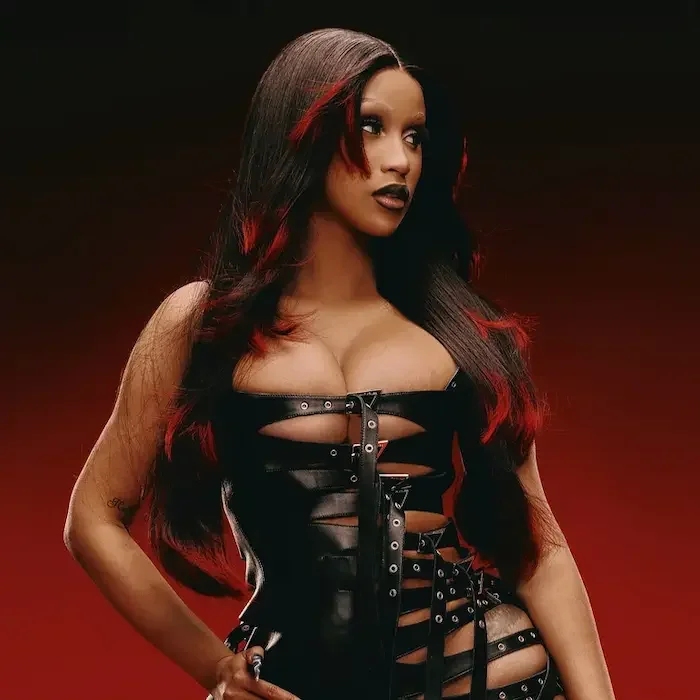
Cardi B entered rap the way very few figures do: making too much noise for the industry to pretend it did not hear her. Before the Grammy, before the No. 1 singles, before the impossible red-carpet looks and the phrases turned into memes, there was already a voice that could not be mistaken for anyone else’s: fast, filthy when it wanted to be, effortlessly funny, streetwise, theatrical, direct, with a way of saying things as if every line had been recorded in the middle of an argument she already knew she was going to win. Her story does not begin in a perfect studio. It begins in the Bronx, on social media, on reality television, in unfiltered conversations and in a personality so large that music eventually had to move toward her.
Belcalis Marlenis Almánzar was born in The Bronx, New York, into a family with Dominican and Trinidadian roots. That Afro-Caribbean and New York background is not a decorative detail; it lives in her accent, her humor, her switches between English and Spanish, and the way she moves between neighborhood, luxury, street, club, fashion and television. Cardi did not arrive as an artist polished by years of mystery. She arrived almost in reverse: too visible, too loud, too real for the traditional mold of the carefully managed female star. Her first fame came through the internet, through videos where she was not selling perfection but presence. People followed her because she said things others thought but would never say with that volume, that laugh and that certainty.
Her time on Love & Hip Hop: New York amplified that energy. Television could have trapped her inside the role of “viral personality,” but Cardi understood something crucial: reality TV was a platform, not a destination. Rather than remain a secondary entertainment figure, she used the attention to move the audience toward music. Her earliest releases, including “Cheap Ass Weave” and the Gangsta Bitch Music mixtapes, still had a raw texture, closer to the sound of a rapper building herself in real time than a finished product. But the essentials were already there: sharp phrasing, comic timing, bodily confidence and a gift for turning personal experience into spectacle without apology.
“Bodak Yellow” changed everything. The song did not sound like an audition. It sounded like a door being kicked open. Over a dark, dry beat, Cardi rapped with an authority that seemed to come from years of having to explain herself, defend herself and get back up alone. “Bodak Yellow” was not merely a huge hit; it was an interruption. A woman from the Bronx, Latina, Black, loud, and unwilling to soften herself into the shapes often demanded of female artists, reached No. 1 on the Hot 100 with a song that did not try to please. It tried to dominate. The success mattered because it turned the authenticity so often treated as excess into a competitive advantage.
Invasion of Privacy arrived under enormous pressure: it had to prove Cardi was not a one-song phenomenon. It did so through a smart mix of trap, New York rap, Latin pop, R&B and confession. “I Like It,” with Bad Bunny and J Balvin, celebrated her Caribbean and Latin identity with global party energy. “Be Careful” revealed a less cartoonish vulnerability, something wounded and controlled. “Money” reinforced her persona as a woman who talks about ambition without shame. “Ring” and “Thru Your Phone” opened more emotional spaces. The album worked because it did not try to clean Cardi up. It let her be huge, contradictory, funny, aggressive, sensual, sentimental and messy. And inside that mess, there was life.
The Grammy win for Best Rap Album confirmed something her audience already understood: Cardi had entered a historically difficult space for women in rap without shrinking her personality to make it more comfortable. The victory did not make the criticism disappear. If anything, from that point on Cardi lived in a permanent tension between celebration and surveillance. Every single, collaboration, album delay and public move seemed to arrive with a question attached: can she sustain this? That pressure, unfair but real, became part of her narrative.
After Invasion of Privacy, Cardi chose an unusual route. She did not flood the market with annual albums; she turned individual singles into events. “WAP,” with Megan Thee Stallion, became a cultural bomb: explicit, funny, scandalous to conservative audiences and liberating to a generation that heard female sexuality as a space of humor, power and exaggeration. “Up” returned to her club-ready, competitive energy. Songs like “Tomorrow 2” with GloRilla and “Bongos” showed that Cardi remained most effective when she found the exact space between viral gesture, sticky phrase and physical presence.
The long wait for her second album turned AM I THE DRAMA? into more than a record. It became a public test. Released in 2025, the project carried seven years of expectation, conversation, doubt, attacks, motherhood, fame, industry change and a less patient public than the one she faced in 2018. The title worked because it understood Cardi’s public image: she does not run from drama; she theatricalizes it. On songs like “Outside,” “Imaginary Playerz” and “Safe,” Cardi moved through confrontation, luxury, desire, score-settling and a clear need to remind rap that her charisma was still a high-impact weapon. The album reaching No. 1 on the Billboard 200 showed that the long wait had not erased her commercial weight.
Cardi B matters because she changed the kind of personality that could dominate mainstream rap. She did not arrive with cool distance or calculated mystery. She arrived with excess, laughter, insult, glamour, long nails, accent, neighborhood energy and a transparency that could be chaotic but was rarely boring. Her music lives on the border between performance and reality, between the woman who knows how to sell spectacle and the woman who still sounds like she is telling the truth on a Bronx corner. At her best, Cardi does not only rap; she occupies the entire room. And in a culture that often demands women be brilliant but controlled, her greatest strength has been refusing to lower the volume.
Main genre
RAP
Main subgenres
Like a superfan's list — except verified, with sources and links.
03–Jul 05, 2026
New Orleans, Louisiana · United States
Past
13–Apr 15, 2023
Pattaya, Chonburi · Thailand
Past
20–Apr 22, 2018
Indio, California · United States
Past13–Apr 15, 2018
Indio, California · United States
PastWhat we managed to link to the concert archive. If a date is missing, tell us — happens to us too.
No linked concerts
Every concert and festival of the year, traced on the globe. Hit play and follow the route stop by stop.
Photos from the public archive.
Recent coverage linked to the artist.


Close by genre and social signal.
No related artists
When there is enough genre signal, they will appear here.