Ranking
#29

Ranking
#29
Followers
178.6 M
Digital presence
Official profiles, streaming and discovery.
What a good fan recites by heart (or pretends to).
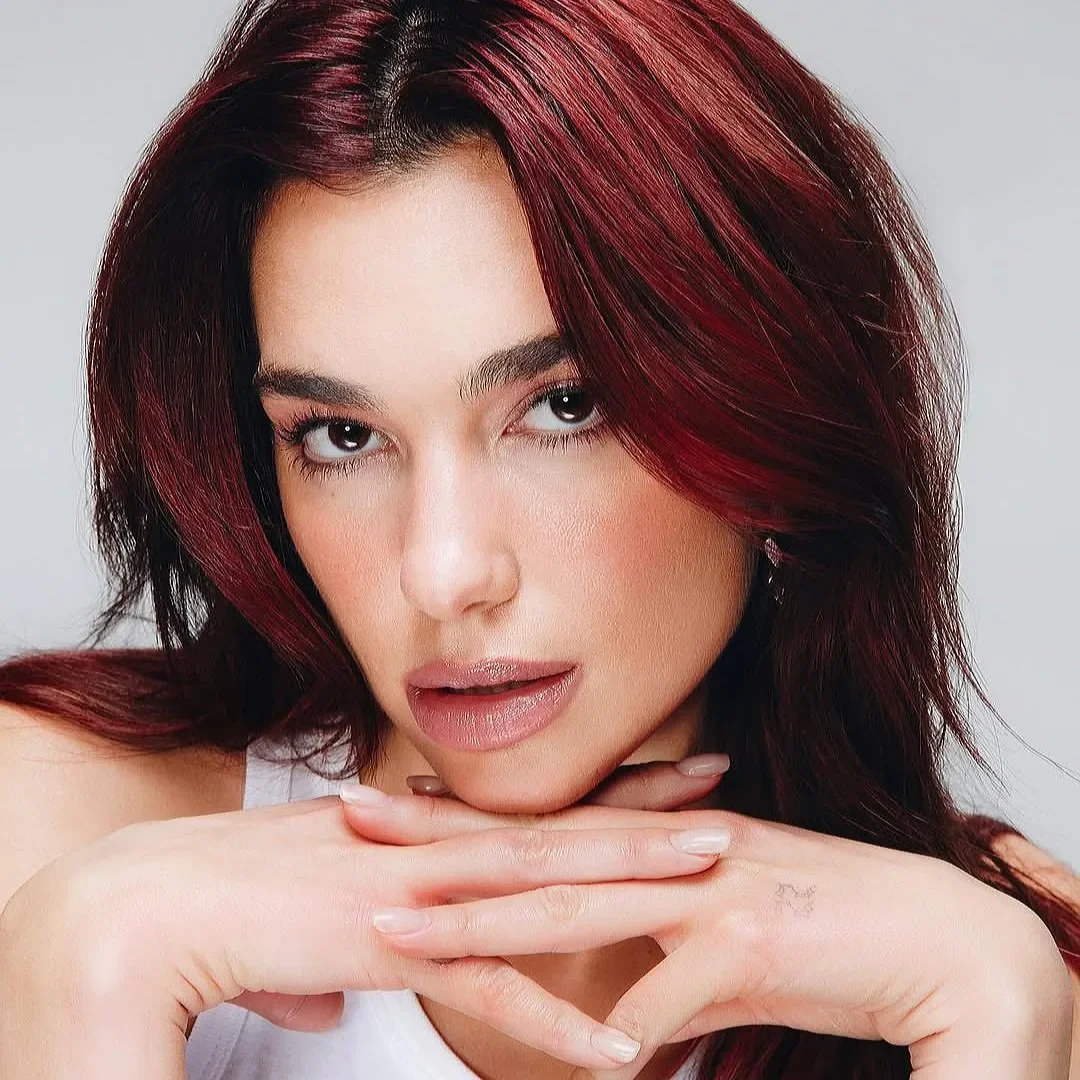
Dua Lipa built her place in pop through an unusual mix of coolness, discipline and dance-floor fire. She did not arrive as the typical teenage star overflowing with emotion, nor as a diva who needed to dramatize every gesture. Her magnetism came from somewhere else: a deep voice, a steady gaze, precise aesthetics, songs designed to move with elegance and a constant sense of control. Even when she sings about breakups, desire or confusion, Dua often sounds like someone who has already decided how she will walk out of the scene. That confidence, as clean as it is dangerous, became her signature.
Born in London and marked by her Kosovar-Albanian heritage, Dua grew up between two emotional centers: the city where she was born and the family territory that always shaped her identity. That crossing gave her a particular idea of pop: global, yes, but also something that can be built from one’s own accent, from migrant ambition, from the desire to belong to more than one place without having to choose only one. Her teenage return to London to pursue music was not a casual dream of fame, but an early decision of scale. Dua wanted to sing, but she also wanted to compete on the big map.
The first years were years of testing and sharpening. “New Love” and “Be the One” introduced a voice with weight, a presence more restrained than many pop debutantes and a taste for club melody that was not yet fully defined. “Hotter Than Hell” and “Blow Your Mind (Mwah)” strengthened the image of a confident, direct, slightly distant girl who could sound sensual without sounding fragile. But the true shift arrived with “New Rules.” The song was not only a hit; it was an emotional choreography for leaving a relationship that should not be repeated. Do not call him, do not let him in, do not be his friend: it became a pop manual for self-preservation, sung from female complicity rather than romantic victimhood.
Her debut album worked because it understood that Dua Lipa did not need to sound excessively dramatic to connect. “IDGAF” continued the logic of emotional boundaries: no more begging, no more negotiating, no more returning to the place where you were broken. There she began to consolidate a figure who spoke about independence in the language of the dance floor. But the leap that would turn her into one of the major architects of 2020s pop was still ahead.
Future Nostalgia was that leap. In the middle of a global lockdown era, Dua released an album that sounded like an imaginary nightclub, an emotional workout, a retro fantasy and a bright future all at once. “Don’t Start Now” was a perfect declaration: elastic bass, modern disco, a breakup already survived and a voice that refused to look back. “Physical” took eighties energy and turned it into contemporary sweat. “Break My Heart” mixed fear of love with elegant groove. “Levitating” turned lightness into a machine of happiness. Future Nostalgia mattered because it did not apologize for being pure pop. It did not justify itself through deep sadness or dark concept. It wanted rhythm, style, precision, pleasure and collective memory.
That era was also an answer to the criticism that had tried to reduce her to memes or stiffness. Dua visibly improved as a performer, worked on her stage body, refined her live presentation and made discipline part of her narrative. Suddenly, the apparent distance of the early years became command. Instead of erasing her limitations, she worked through them until they became part of a stronger figure. Her success no longer looked accidental; it looked built.
“Dance the Night,” for Barbie, confirmed her ability to make pop that is functional and sophisticated at the same time: a movie song, yes, but also one that understood sparkle, irony and melancholy behind a perfectly lit dance floor. Then Radical Optimism opened a looser, more psychedelic, more Mediterranean phase, less obsessed with repeating the disco formula. “Houdini,” “Training Season” and “Illusion” kept the club pulse, but with a more liquid feeling, as if Dua were trying to dance not only to forget, but to accept chaos with elegance.
The idea of radical optimism fits her because it does not sound naïve in her voice. Dua does not sing as if the world were easy; she sings as if she can move through it with rhythm, intelligence, impeccable clothes and a clear phrase. Her recent universe has also expanded beyond music: acting, fashion, Service95, a book club, interviews, cultural curiosity and the image of a pop artist who wants to be more than a list of singles. It is not only about being famous, but about building an ecosystem around taste.
Dua Lipa matters because she brought back to pop an idea of disciplined, modern, physical glamour. Her music understands that a great dance song can also be an emotional statement; that pleasure can have structure; that independence can sound like bass, clap and chorus. At her best, Dua does not seem to chase the party. She walks in, adjusts the lights and decides when it begins.
Main genre
POP
Main subgenres
Like a superfan's list — except verified, with sources and links.
02–Sep 11, 2022
Rio de Janeiro, Rio de Janeiro · Brazil
Past
09–Jun 11, 2022
Barcelona, Catalunya · Spain
PastWhat we managed to link to the concert archive. If a date is missing, tell us — happens to us too.
No linked concerts
Every concert and festival of the year, traced on the globe. Hit play and follow the route stop by stop.
Photos from the public archive.
Recent coverage linked to the artist.


Close by genre and social signal.
No related artists
When there is enough genre signal, they will appear here.