Ranking
#2

Ranking
#2
Followers
627.5 M
Digital presence
Official profiles, streaming and discovery.
What a good fan recites by heart (or pretends to).
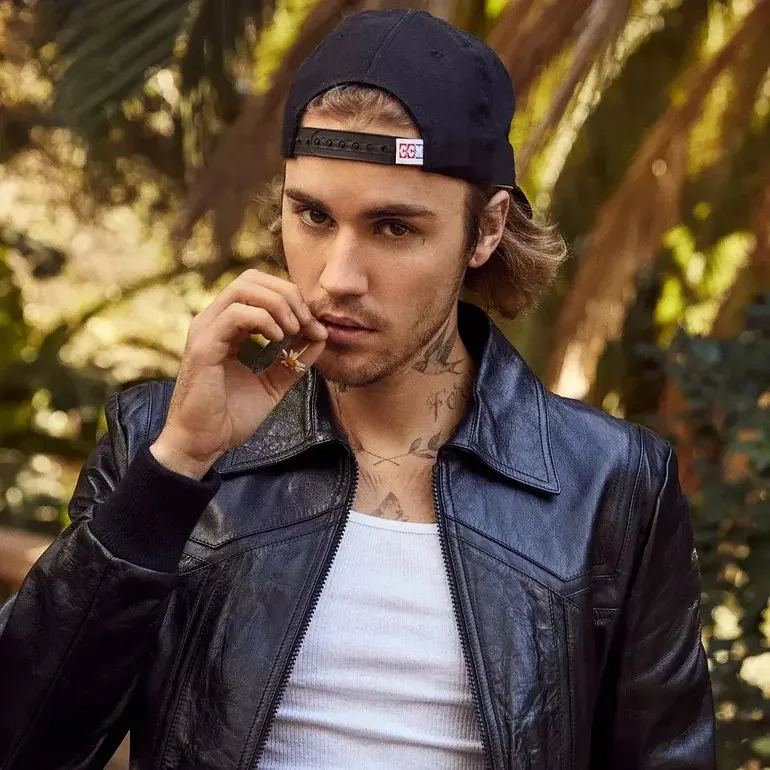
Justin Bieber is one of the clearest examples of how pop fame changed in the twenty-first century. Before TikTok made overnight stardom feel routine, before labels built entire strategies around viral metrics, before the phrase “discovered online” became almost ordinary, there was a Canadian kid singing R&B covers into a home camera. That simple image — almost innocent now — opened one of the most intense, scrutinized and contradictory pop careers of the modern era. Bieber was not just a teenage star. He became a test case for digital fame, fan devotion, mass backlash, adult reinvention and the emotional cost of growing up in public.
Born in London, Ontario, and raised in Stratford, Justin Drew Bieber began far from the traditional machinery of global pop. His origin story has the structure of a modern myth: family videos uploaded to YouTube, a young voice covering R&B songs, Scooter Braun stumbling onto the clips, a trip to Atlanta, Usher’s involvement, and suddenly a child performer surrounded by the full force of the music industry. Within a few years, Bieber moved from local talent shows and homemade videos to shopping-mall chaos, airport crowds, television appearances, arenas and the kind of screaming audience that turns a young singer into a cultural event before he has even had time to become an adult.
His early era belongs to the history of teen pop, but it also belongs to the history of the internet. My World and My World 2.0 did not simply introduce songs; they introduced a new kind of closeness between artist and audience. “One Time” and “Baby” worked because they were immediate, bright and emotionally uncomplicated, made for an audience that did not want distance from its idol. The hair, the hoodie, the smile, the YouTube backstory, the interviews and the Beliebers were all part of the same cultural package. Bieber did not feel like a star descending from an unreachable industry tower. He felt like someone who had come out of a familiar screen and suddenly occupied the center of global pop.
That closeness came with a price. Bieber grew up under a level of public pressure that is hard to measure from the outside. The awkwardness most teenagers get to survive privately became, in his case, headline material, tabloid spectacle, meme culture, moral judgment and constant surveillance. That is why his career cannot be read only as a list of hits. It is also a story about pressure. The boy from “Baby” became a deeply polarizing figure: adored with near-religious intensity by millions of fans and rejected just as loudly by people who saw him as the embodiment of everything they disliked about young pop. For years, Justin Bieber was a singer, a product, a phenomenon, a punching bag and a generational symbol all at once.
Musically, the adult transition began to take shape with Believe. “Boyfriend” signaled a clear change: less childhood innocence, more urban-pop styling, more flirtation, a voice no longer able to sell itself as purely adolescent. But the more revealing turn came with Journals and then, decisively, Purpose. Journals became an important cult chapter because it showed Bieber’s pull toward R&B, late-night textures and a more intimate emotional language. Purpose made that reinvention massive. “Where Are Ü Now,” with Skrillex and Diplo, repositioned him inside adult electronic pop; “What Do You Mean?,” “Sorry” and “Love Yourself” turned that new phase into global dominance. Bieber was no longer simply the kid people loved or hated out of habit. He had become musically unavoidable again.
What makes Purpose so important is that it did not erase the earlier Bieber; it reframed him. The production felt sharper and more current, the tone more vulnerable, the public character more aware of damage and apology. “Sorry” could sound like a tropical-pop release of energy while still carrying the weight of asking forgiveness. “Love Yourself” had a cold acoustic precision: a breakup song so clean that millions could sing it as if it were their own private last word. That mixture of regret, lightness, melody and self-conscious redemption made Bieber more complicated than a recycled teen idol. His public fragility began to speak through the music rather than sit outside it.
The years that followed were uneven, but they were also revealing. Changes leaned into R&B, marriage, domestic intimacy and softer production, though its mood divided listeners. Justice returned him to a broader pop stage, with songs like “Peaches,” “Anyone,” “Lonely” and “Ghost” showing different sides of his adult voice. That period also proved how flexible he could be as a collaborator: Daniel Caesar, Givēon, Benny Blanco, Chance the Rapper, The Kid LAROI and others helped place him across melodic R&B, spiritual pop, confessional balladry and streaming-era hooks. “Stay,” with The Kid LAROI, showed that Bieber’s voice remained one of the most recognizable instruments in global pop: light, nasal, agile and emotionally direct.
The pause after Justice changed the frame again. His Ramsay Hunt syndrome diagnosis, the cancellation of the remaining Justice World Tour dates and his public absence shifted the conversation away from pure commercial performance. There was a more human question beneath it: how much can one person endure after being watched, judged and demanded from since early adolescence? That is why SWAG and SWAG II, released in 2025, landed with a different kind of weight. They were not simply new Justin Bieber albums. They were return projects, documents of recalibration, attempts to build a more adult sound rooted in R&B, soul textures, indie-pop looseness and less obvious radio-chasing.
In this recent phase, Bieber sounds more interested in texture than perfection, more drawn to atmosphere than to the cleanest possible hook. There are traces of contemporary soul, soft-focus R&B, spiritual searching and a more tired, domestic, less polished masculinity. Not every idea lands with the same force, but the intention is clear: he is trying to escape the cartoon versions of himself. After years of being reduced to child prodigy, troubled celebrity, famous husband, recovering patient or automatic hitmaker, Bieber seems increasingly interested in sounding like someone who no longer wants to carry the obligation of being the center of pop at every moment.
Justin Bieber matters because his career contains several stories at once. He is the YouTube kid, the teen idol, the object of backlash, the artist who found credibility through Purpose, the collaborator who moved through pop, EDM, R&B, country-pop and Latin music, and the adult trying to rebuild without losing the emotional thread that connected him to his earliest fans. His music has not always been perfect, his exposure has not always been healthy, and his public image has rarely been simple. But that is exactly where his cultural importance lives. Justin Bieber is one of the most visible examples of what happens when an entire generation watches a star grow up in real time — with all the brightness, discomfort, fascination and humanity that comes with it.
Main genre
POP
Main subgenres
Like a superfan's list — except verified, with sources and links.

17–Apr 19, 2026
Indio, California · United States
Past10–Apr 12, 2026
Indio, California · United States
Past
02–Sep 11, 2022
Rio de Janeiro, Rio de Janeiro · Brazil
PastWhat we managed to link to the concert archive. If a date is missing, tell us — happens to us too.
No linked concerts
Every concert and festival of the year, traced on the globe. Hit play and follow the route stop by stop.
Photos from the public archive.
Recent coverage linked to the artist.


Close by genre and social signal.
No related artists
When there is enough genre signal, they will appear here.