Ranking
#6

Ranking
#6
Followers
454.7 M
Digital presence
Official profiles, streaming and discovery.
What a good fan recites by heart (or pretends to).
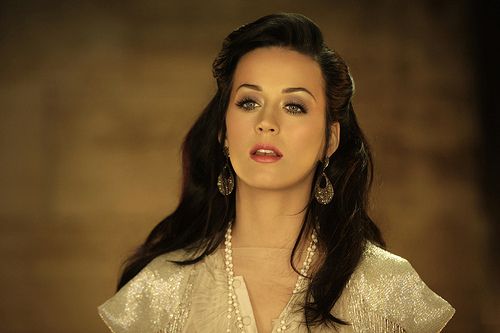
Katy Perry is one of the great builders of oversized pop: songs made of bright lights, giant hooks, humor, exaggeration, romance, desire, cartoon logic and an almost theatrical belief in the power of a chorus. Her career is not explained only by the numbers, although the numbers are massive. It is explained by the way she turned late-2000s and early-2010s pop into a place of maximal fantasy, where a song could feel like endless summer, teenage heartbreak, a saturated-color movie, a California party or a motivational phrase written across the sky in fireworks.
Before she was Katy Perry, she was Katheryn Elizabeth Hudson, a girl from Santa Barbara raised in a strict Christian environment, surrounded by religious music, hymns and gospel. That background matters because her entrance into mainstream pop was not the story of someone born inside the secular culture she would later dominate. Her first album, Katy Hudson, belonged to the gospel world and passed with little commercial impact. But it left something behind: the instinct to sing with size, to project emotion toward an audience, to treat the voice as a kind of declaration. When she later changed her name, style and musical language, she was not starting from zero; she was breaking through a door she had already been pushing for years.
The breakthrough came with One of the Boys. “I Kissed a Girl” was provocation, pop hook and cultural friction in one song. With distance, it can be read in more complicated ways, but in 2008 it worked as an entrance impossible to ignore. Perry arrived as playful, bold and theatrical, mixing modern pin-up imagery, pop rock, irony and radio ambition. “Hot N Cold” confirmed that she was not just a one-song controversy. There was a precise melodic instinct there, a sense of contrast, a way of turning a simple emotional switch into a chorus anyone could shout.
Then came Teenage Dream, and Perry reached one of the highest peaks of modern commercial pop. That album was a perfectly coordinated machine of image, identity and singles. “California Gurls” opened the door to a universe of palm trees, sugar, bronzed bodies, impossible beaches and pop as a bright cartoon version of the West Coast. “Teenage Dream” captured the rush of love that feels new even when it is not. “Firework” turned self-affirmation into collective spectacle. “E.T.” pushed desire into a darker, alien fantasy. “Last Friday Night (T.G.I.F.)” transformed hangover chaos into pop comedy. What made that era extraordinary was not only that the songs worked individually, but that together they built a world instantly recognizable.
Katy understood something essential: pop does not always need subtlety to be smart. Sometimes it needs scale, timing, an image that sticks and a phrase simple enough to become part of millions of people’s vocabulary. Her strength was controlled excess. Cupcake dresses, blue wigs, impossible stages, saturated videos, cartoon humor, light sensuality, direct messages and a voice tougher than it is sometimes given credit for. Onstage, that aesthetic became a kind of emotional theme park around her songs. Her shows were not trying to look small or intimate; they were built to turn pop into spectacle.
Prism shifted the tone without abandoning the big gesture. “Roar” was a survival statement, a comeback anthem that placed her back at the center. “Dark Horse” showed her talent for absorbing trends, blending pop with trap elements and turning a darker beat into a global hit. But after that moment, her relationship with the public became more complicated. Witness tried to present her as more conscious, more political, more adult, but the shift in image and language did not connect as naturally as her earlier eras. “Chained to the Rhythm” remains one of the strongest ideas from that period: a dance song about comfort, distraction and social repetition. The difficulty was that pop itself had begun moving toward a different kind of intimacy: less cartoonish, more confessional, less dependent on the grand visual universe.
Smile came from a more vulnerable place, with Perry speaking about falling, emotional health and rebuilding. “Never Really Over” proved that her pop instinct was still alive: circular melody, romantic anxiety, bright energy. But the decade had changed. Pop stars in the digital era were no longer competing only for hits; they were competing for narrative, closeness, permanent authenticity and cultural speed. Perry, who had dominated an age of huge videos and universal choruses, had to find her place in a more fragmented ecosystem.
143, her 2024 dance-pop return, pushed her back toward shine, club energy and lightness. Its reception was uneven, but The Lifetimes Tour reminded people of something important: Katy Perry has a catalog with enormous collective memory. At a Katy Perry show, songs are not just songs. Entire periods of pop culture reappear. The summer of “California Gurls,” the communal shout of “Firework,” the confidence of “Roar,” the strange darkness of “Dark Horse,” the nostalgia of “Teenage Dream.” The audience is not only there for new material; it is also there to reconnect with a part of its adolescence, youth or early adulthood.
Katy Perry matters because she represents a form of pop that feels less common now: big, frontal, colorful, unafraid of silliness, built for enormous stages and simple but effective emotions. Her career has included reinventions, missteps and moments of disconnection, but it has also left a very clear mark. For several years, Perry made pop feel like a neon world where everything was larger than real life: love, parties, sadness, confidence, costume, collapse and comeback. That remains her strongest identity: an artist who turned excess into language and the pop chorus into shared fireworks.
Main genre
POP
Main subgenres
Like a superfan's list — except verified, with sources and links.
21–Jul 26, 2026
Nyon · Switzerland
Past
Jun 24 – Jul 29, 2026
Lucca · Italy
Past
20–Jun 28, 2026
Portugal
Past
13–Sep 22, 2024
Rio de Janeiro, Rio de Janeiro · Brazil
Past18–Sep 27, 2015
Rio de Janeiro, Rio de Janeiro · Brazil
PastSep 23 – Oct 02, 2011
Rio de Janeiro, Rio de Janeiro · Brazil
PastWhat we managed to link to the concert archive. If a date is missing, tell us — happens to us too.
No linked concerts
Every concert and festival of the year, traced on the globe. Hit play and follow the route stop by stop.
Photos from the public archive.
Recent coverage linked to the artist.


Close by genre and social signal.
No related artists
When there is enough genre signal, they will appear here.