Ranking
#5

Ranking
#5
Followers
467.2 M
Digital presence
Official profiles, streaming and discovery.
What a good fan recites by heart (or pretends to).
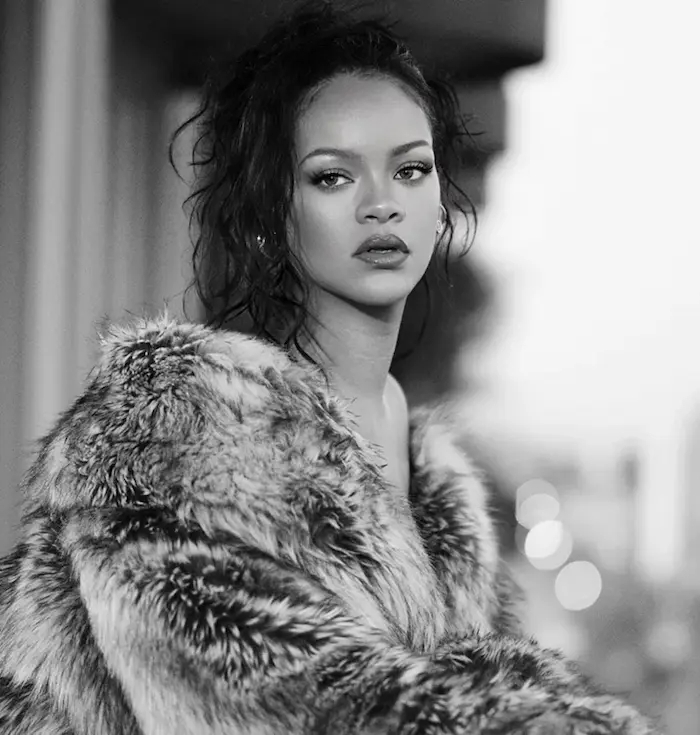
Rihanna is not best understood simply as a hitmaker. She is better understood as a cultural presence who learned how to change skins before the public had finished adjusting to the last one. Some artists build one identity and defend it for years; Rihanna has spent much of her career doing the opposite. From Barbados to the center of global pop, she moved through different sonic islands: dancehall, R&B, electronic pop, dark ballads, club music, hip-hop, reggae, trap, soul, luxury, streetwear, fashion and silence. Yet something remains constant in every version: the way she sings as if she does not need to convince anyone, that mix of distance, ease and control that made her almost impossible to imitate without sounding like a pose.
Robyn Rihanna Fenty was born in Saint Michael, Barbados, and that origin is not decorative. Before she became a global pop star shaped by American radio, she came from a musical culture where reggae, dancehall, soca and R&B moved naturally through everyday life. Her first public image was not that of an artist engineered to dominate every market, but of a Caribbean teenager who caught the attention of producer Evan Rogers, recorded a demo and eventually auditioned for Jay-Z at Def Jam. It has the outline of a classic pop discovery story, but what followed was far less predictable.
“Pon de Replay,” from *Music of the Sun*, introduced her as a new Caribbean voice inside mid-2000s pop. It was built for movement: dance floor, summer radio, teenage parties, island accent filtered through international production. *A Girl Like Me* expanded that first image with “SOS” and “Unfaithful,” but the true rupture came with *Good Girl Gone Bad*. That was the moment Rihanna stopped looking like a promising tropical-pop newcomer and became a top-tier pop figure. “Umbrella” was not just a massive hit. It was the point where the world began to see her as something larger: the haircut, the video, the Jay-Z opening, the hook, the cool, controlled attitude. Everything worked as the arrival of a star who no longer needed permission.
What made Rihanna interesting is that she never stayed in one room for too long. *Rated R* darkened the image after the gloss of *Good Girl Gone Bad*. It sounded harder, colder, more nocturnal, with “Russian Roulette” and “Hard” giving shape to a tense emotional and aesthetic period. Then *Loud* changed the color again: vivid red, expansive pop, direct sensuality, massive choruses. “Only Girl (In the World),” “What’s My Name?” and “S&M” placed her at a perfect intersection of club, radio and provocation. With *Talk That Talk*, “We Found Love” pushed that club connection into something almost euphoric: dance-pop as excess, escape and free fall.
Still, Rihanna has often been most compelling when pop seemed slightly too small for her. *Unapologetic* mixed desire, hardness, luxury and vulnerability through “Diamonds,” “Stay” and “Pour It Up.” By then, she was not just an adaptable singer; she had become a curator of atmosphere. She knew how to take producers, genres and trends and make them feel like part of her own weather. Her central talent has never been limited to traditional authorship. It is instinct: choosing the right tone, knowing when to sound indifferent, when to let the voice crack, when to make a line feel casual even as it becomes part of a decade’s vocabulary.
*ANTI* was the artistic confirmation. After years of huge singles, Rihanna delivered an album less interested in obvious expectation and more committed to texture, personality and risk. “Work” returned to Caribbean rhythm without turning it into a postcard. “Needed Me” sounded cold, minimal and lethal. “Love on the Brain” revealed a rougher soul edge. “Higher” felt like it had been recorded from inside an open wound. “Consideration” opened the album like a declaration of independence. *ANTI* mattered because it was not designed as an easy greatest-hits machine. It proved Rihanna could build a world of her own: messy, stylish, intimate, defiant.
Then came one of the most famous recording silences in modern pop. Since 2016, every Rihanna music appearance has carried extra weight because the public is waiting for a comeback that never quite arrives on schedule. “Lift Me Up,” for *Black Panther: Wakanda Forever*, was not the dance-floor return many expected. It was solemn, almost ceremonial, a tribute ballad that placed her voice inside grief and memory. Her Super Bowl LVII Halftime Show worked as a reminder of catalog power: Rihanna suspended above the field, pregnant, moving through more than a decade of songs that the audience still knew by heart, needing fewer tricks than almost anyone expected.
Outside music, Rihanna changed the conversation around beauty and fashion through Fenty Beauty and Savage X Fenty. Her business impact did not feel like a celebrity side project; it felt like an extension of her eye: inclusion, skin tone, body, desire, accessible luxury, self-definition. Fenty Beauty’s arrival forced parts of the beauty industry to answer for who had been left out. Her recognition as a National Hero of Barbados closed another circle: the girl from the island becoming a global symbol without entirely erasing where she came from.
Rihanna matters because her career shows that pop can also be attitude, selection, silence and presence. She does not need to release music every year to occupy cultural space. Her absence has become part of her power, but the songs endure for reasons deeper than nostalgia. At her best, Rihanna sounds like someone who has seen the party from the inside and the outside, someone who knows when to enter, when to leave and when to let everyone keep waiting.
Main genre
POP
Main subgenres
Like a superfan's list — except verified, with sources and links.
18–Sep 27, 2015
Rio de Janeiro, Rio de Janeiro · Brazil
PastSep 23 – Oct 02, 2011
Rio de Janeiro, Rio de Janeiro · Brazil
Past
03–Jul 06, 2008
New Orleans, Louisiana · United States
PastWhat we managed to link to the concert archive. If a date is missing, tell us — happens to us too.
No linked concerts
Every concert and festival of the year, traced on the globe. Hit play and follow the route stop by stop.
Photos from the public archive.
Recent coverage linked to the artist.


Close by genre and social signal.
No related artists
When there is enough genre signal, they will appear here.