Ranking
#1,255

Ranking
#1,255
15 editions to explore · future, live and past
Numbers, home base and house quirks
There is something almost disproportionate about the relationship between Cambridge Folk Festival and Cherry Hinton Hall. The festival carries more than six decades of history, generations of musicians and a roll call of artists large enough to belong to a national institution, yet its spiritual home remains a relatively intimate park in Cambridge. That scale is part of the explanation for its longevity. Cambridge has rarely needed physical enormity to communicate importance. Trees, grass, marquees, conversations between performances and stages where established artists can be followed by musicians still building an audience have created a continuity that returning festivalgoers recognise immediately. Even after the substantial redesign introduced in 2026, Cherry Hinton Hall remains the place against which every other part of the festival is measured.
The first event took place on July 31 and August 1, 1965. Cambridge City Council had decided to support a folk festival, and local firefighter and political activist Ken Woollard became the organiser who would shape its artistic identity until his death in 1993. The inaugural bill already reads remarkably well in retrospect: The Clancy Brothers & Tommy Makem, Peggy Seeger, The Watersons, Shirley Collins and a young Paul Simon were among the performers. Around 1,400 tickets were sold. At the time, however, this was still an experiment built in the middle of the folk revival, when traditional song, political writing and a new generation of singer-songwriters were colliding in Britain with material arriving from Ireland and the United States.
Woollard’s most lasting instinct may have been refusing to police the word “folk” too closely. Cambridge developed a definition broad enough to contain British and Irish traditions, blues, country, Americana, folk-rock and music from far beyond the Anglo-American world. Joan Baez, Emmylou Harris, Van Morrison, James Taylor, Peggy Seeger, Richard Thompson, The Pogues, Robert Plant, Nick Cave, Sinéad O’Connor and Suzanne Vega belong to very different parts of that history. At the same time, the festival became unusually good at putting future headliners on smaller stages before their careers had fully arrived. Passenger, Frank Turner, Jake Bugg and First Aid Kit are among the artists later cited as examples of Cambridge functioning as a launch pad rather than simply a home for established names.
That discovery culture extended beyond the main bill. Workshops, folk clubs, ceilidhs, dance, street performance, sessions and informal participation gave the weekend a rhythm that did not revolve entirely around waiting for the final artist each night. Camping reinforced a generational community, with families returning year after year and children growing into adult festivalgoers without necessarily changing their summer destination. For decades the physical model remained strikingly consistent: several days at Cherry Hinton Hall, multiple stages and an audience willing to accept that “folk” might describe everything from unaccompanied traditional singing to an electric band, a country songwriter or an artist arriving with musical traditions from another continent. Professional production grew around that idea without turning Cambridge into a giant greenfield festival.
The pandemic created one of the rare breaks in that continuity. There were no normal in-person festivals in 2020 or 2021, before a full return in 2022. Yet the more existential challenge arrived several years later. Infrastructure, labour, insurance and other delivery costs were climbing while ticket and camping income failed to recover sufficiently. The 2024 festival produced a deficit of more than £320,000. For a publicly organised event operating within a city council facing its own budget pressures, that loss raised a harder question than whether one edition had gone badly: could the traditional four-day model still exist without requiring substantial recurring public subsidy? Cambridge City Council designated 2025 as a fallow year and used the pause to rethink the event rather than quietly allow it to disappear.
The answer in 2026 was to preserve the identity while changing the geography. Cambridge Folk Festival became more explicitly city-wide, with concerts and projects appearing across local venues during July, including activity at Cambridge Corn Exchange and partnerships with folk clubs and cultural organisations. Cherry Hinton Hall remained the anchor but the main outdoor celebration was reduced to two days. Basic camping survived, as did two principal music stages, street performers and Club Corner. For long-term devotees, losing the old four-day structure inevitably changed the sensation of arrival. Yet the alternative was much more serious: council documents acknowledged that outright closure had been a genuine possibility if a financially resilient model could not be found.
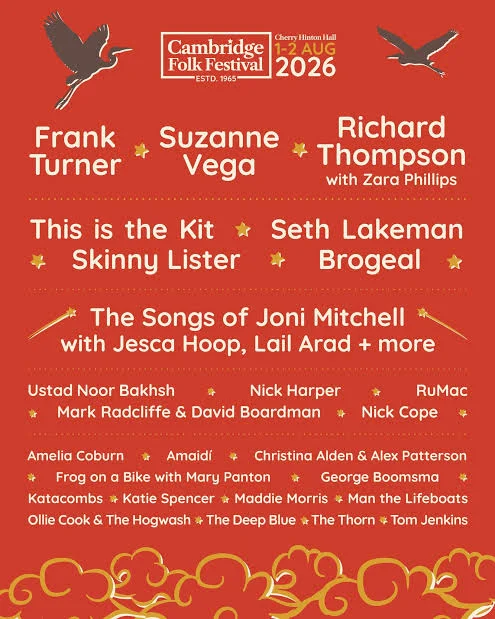
The August 1–2, 2026 return sold out. Frank Turner made an unusually appropriate headliner, connecting acoustic songwriting, punk energy and the constantly shifting boundaries of modern folk. Suzanne Vega brought a catalogue built on precision rather than spectacle, while Richard Thompson linked the revived format directly back to British folk-rock history. Seth Lakeman, This Is The Kit, Skinny Lister, Ustad Noor Bakhsh, Brogeal, Nick Harper and numerous local and emerging performers gave the bill the breadth Cambridge has long depended on. The central weekend was shorter than the old festival, but the wider programme meant the event had also begun occupying more of the city rather than concentrating every encounter behind one set of gates.
A 2027 edition is already confirmed, with activity planned through July and the Cherry Hinton Hall finale ending on August 1. That matters because it positions the 2026 redesign as the beginning of another phase rather than a one-year rescue attempt. Cambridge Folk Festival has now reached an age when continuity cannot mean preserving every structural detail. The park remains, the city remains responsible for the event and musicians still arrive carrying different ideas of what folk can contain. Perhaps that is the tradition worth protecting most carefully. Since 1965, Cambridge has treated roots not as a reason to stay still, but as something strong enough to allow the music above them to keep changing.
Timeline
One artist per year — highest ranked in our archive
Those who appear most across this franchise's editions.
 #1
#1United Kingdom
1 editions · 2026
 #2
#2United Kingdom
1 editions · 2026
 #3
#3United Kingdom
1 editions · 2026