Ranking
#1,255

Ranking
#1,255
When
2027
Featured artists
Lineup coming — we'll publish it as soon as it's confirmed.
13 editions to explore · future, live and past
Numbers, home base and house quirks
Cambridge Rock Festival has retained something that larger events often lose: the sense that the person pulling a pint, the volunteer checking a wristband and the fan who has been coming for twenty years may all belong to the same extended conversation. That feeling is structural rather than accidental. The festival is still built around a family, volunteer organisers and an audience that has learned to rebuild the weekend every time the address changes. And it has changed repeatedly. Huntingdon, Godmanchester, Barton, Horseheath, Peterborough and now Stuntney form an unusually mobile history for an event whose name sounds geographically fixed. Cambridge Rock Festival has never really depended on one field. Its home is the way those four days are assembled.
It began in 2004 with a name that described the formula almost literally: Rockinbeerfest. Huntingdon Racecourse hosted three days headed by Dr Feelgood, The Stranglers and Wishbone Ash, with Caravan, Eddie and the Hotrods, Ezio, Stray and a long supporting bill moving between rock, blues and folk-rock. Real ale was not a decorative theme added later; it sat beside the music from the beginning. The event returned under the Rockinbeerfest name in 2005 and 2006 before becoming Cambridge Rock Festival in 2007. The new identity sounded more established, but the underlying proposition barely changed: musicianship, guitar music, beer from smaller breweries and a family-run atmosphere that deliberately resisted the anonymous machinery of a corporate festival.
The following years can almost be mapped through venue changes. After Huntingdon Racecourse came Wood Green Animal Shelter in Godmanchester, where audiences could camp beside an unusual permanent events complex. In 2009 the festival moved to Haggis Farm Polo Club near Cambridge, which became its most familiar home for much of the next decade. Horseheath Lodge hosted 2017 and 2018 before a return to Haggis Farm in 2019. None of these moves represented a rebrand or new franchise. They were practical responses to availability and production needs. Ironically, the lack of one permanent site helped prove what the event actually depended on: people were following the festival rather than a location.
Musically, it has never been coy about its audience. Classic rock, progressive rock and blues-rock sit at the centre, with hard rock, folk-rock, metal and acoustic music around the edges. Asia, Uriah Heep, Magnum, Thunder, Focus, Caravan, FM, Tygers of Pan Tang, Don Airey, Praying Mantis, Wishbone Ash and Carl Palmer’s ELP Legacy place it firmly inside a particular British rock tradition. Yet the lower reaches of the bill matter almost as much. Local and developing artists are given substantial space, and bands often return as their audiences grow. Mostly Autumn have become almost inseparable from the festival, appearing in virtually every era after missing the inaugural year.
The practical details reinforce that continuity. Cambridge Rock Festival operates its own real-ale and farmhouse-cider bar, historically offering dozens upon dozens of choices from smaller breweries. Those sales are economically important because organisers describe the event as self-sustaining rather than profit-generating for themselves. Camping sits close to the arena, caravans and motorhomes are accommodated, and covered performance areas make obvious sense in an English summer. This is not a festival built around luxury installations or giant brand activations. Its memorable details are more ordinary: musicians watching other musicians, families returning together, dogs wearing hearing protection and regulars discussing which small band on the Sapphire stage deserves a larger slot next time.
Survival has repeatedly tested that model. There was no full summer Cambridge Rock Festival in 2015, only a smaller SpringFest. COVID-19 then removed the physical 2020 event, so organisers assembled a virtual edition from archived performance footage. A planned move to East of England Showground in Peterborough was delayed through 2021 and finally became reality in 2022. The permanent infrastructure there was supposed to reduce the enormous volunteer labour required to build a temporary greenfield event, but the showground itself was subsequently earmarked for redevelopment. Another proposed festival in 2023 was cancelled amid licensing difficulties. For an independently financed organisation, keeping the name alive through those interruptions was an achievement separate from anything happening onstage.
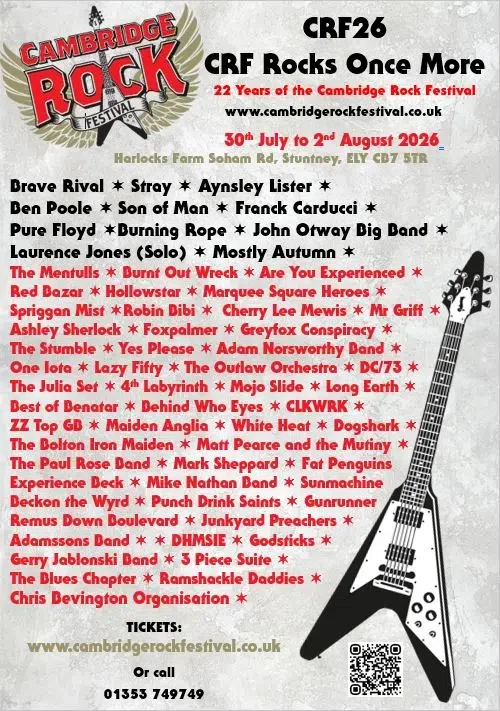
A new chapter started in 2024 at Harlock’s Farm beside Ben’s Yard near Ely. Three covered stages — Ruby, Emerald and Sapphire — restored a compact format, accompanied by camping, bars and the familiar volunteer operation. The festival returned there in 2025 and again from July 30 to August 2, 2026. Franck Carducci, Brave Rival, Mostly Autumn, Dare, Stray, Aynsley Lister, Ben Poole, Burnt Out Wreck, Godsticks, Hollowstar, Spriggan Mist and The John Otway Big Band were among the names spread across that latest weekend. The bill was not designed around one enormous mainstream headliner. The pleasure came from moving between tents for hours and hearing different generations of musicians operating within the broadest definition of rock.
No official 2027 edition had been dated by August 2026. Given the festival’s history, that is a reason to wait for confirmation rather than to invent certainty, not evidence that the project has ended. Cambridge Rock Festival has survived precisely because it has learned not to confuse continuity with permanence. It has lost years, changed names, crossed Cambridgeshire and watched venues become unavailable. What remains is portable: volunteers, real ale, loyal bands and an audience prepared to follow them into another field. As long as those elements can be assembled again, the address is almost secondary. The festival’s most convincing home has always been wherever the amplifiers are switched on next.
Timeline
One artist per year — highest ranked in our archive
Those who appear most across this franchise's editions.