Ranking
#1,255

Ranking
#1,255
When
AUG 02, 2027
Featured artists
Lineup coming — we'll publish it as soon as it's confirmed.
Time left
2 editions to explore · future, live and past
 2027
2027Camp Summerdaze 2027
 2026
2026Camp Summerdaze 2026
Numbers, home base and house quirks
Camp Summerdaze often makes the most sense once the conventional idea of a main stage begins to disappear. The forest is dark, music is travelling between trees, and somebody who spent the afternoon in breathwork may now be barefoot in front of a DJ with no particular interest in checking the time. That tension is the festival’s centre. Camp Summerdaze is not simply an electronic party relocated to the countryside, but neither is it a wellness retreat that added DJs to make the evenings more exciting. Movement and stillness, dance floor and forest, release and introspection are deliberately kept close enough to affect one another.
The story began years before anybody camped. Jordana and Nabil Zakaria had returned to Toronto after spending time in Europe and missed the daytime parties they associated with London and Ibiza. In 2010, alongside Sandra Dalla Giustina, they organised a Summerdaze gathering on a large Queen Street rooftop. Around 150 friends were expected; roughly 600 people arrived. That surprise turned an experiment into a recurring series of Sunday sessions built around house music, unusual locations, food and a more social atmosphere than the city’s normal late-night club circuit. Summerdaze moved through rooftops, patios and temporary Toronto venues before asking what might happen if everybody stayed together after the music stopped.
The first answer came in 2015 at Artscape Gibraltar Point on Toronto Island. Camp Summerdaze extended the party into sleeping, eating, waking and spending an entire weekend together. The camp paused in 2016 while the organisers reconsidered what it could become, then returned in 2017 with a much broader identity. Mark Farina, Desert Hearts, Eduardo Castillo, Tone Of Arc and Lemon Bucket Orkestra shared a rural Schomberg property with yoga, meditation, healers, speakers and workshops. The change was fundamental. More hours of music were no longer the objective. The festival was beginning to treat music as one of several ways of interrupting everyday routines and creating a temporary state of attention.
The landscape kept changing over the following years. Camp Summerdaze used different Ontario properties with lakes, cabins, forest and open land, gradually travelling farther from its Toronto origins. That mobility created memorable environments but also meant rebuilding the concept around somebody else’s property each summer. The decisive move came when the community established itself on its own roughly 100-acre off-grid site in Southeastern Algonquin. The exact address is intentionally shared only with confirmed campers. The forest is not ornamental greenery surrounding an urban venue. Trails, water, darkness and the practical realities of an off-grid property shape the entire weekend. Camp Summerdaze finally had land that could evolve along with the event.
Musically, the festival has remained rooted in underground electronic culture while widening its vocabulary. House is still the backbone, particularly deep, Afro, melodic and minimal strains, with techno, bass and more organic live electronics moving around it. Mark Farina, Tim Green, Eduardo Castillo, Kollektiv Turmstrasse, Robag Wruhme, Rampue, Amine K, Super Flu, Oliver Koletzki, Traumer, Joplyn, Rodrigo Gallardo and Ardalan reflect different points in that trajectory. The emphasis is not on giant EDM spectacle or creating a drop that can be seen from the far side of a field. Dance floors are most convincing here when they remain human enough for people to recognise one another.
Daytime supplies the other half. Yoga, breathwork, cacao, movement, meditation, art classes, conversations and healing practices occupy hours that another electronic festival might leave as recovery time. Campers are encouraged to use the programme rather than simply endure the day until music starts again. Morning can begin quietly, move through a workshop or forest walk and eventually accelerate towards the dance floor. A Kids Camp and Family Camp have also emerged, allowing some of the original Toronto community to return with children. That generational shift gives the event an unusual continuity: the people who first came for Sunday house parties are not required to preserve exactly the same lives in order to remain connected to Summerdaze.
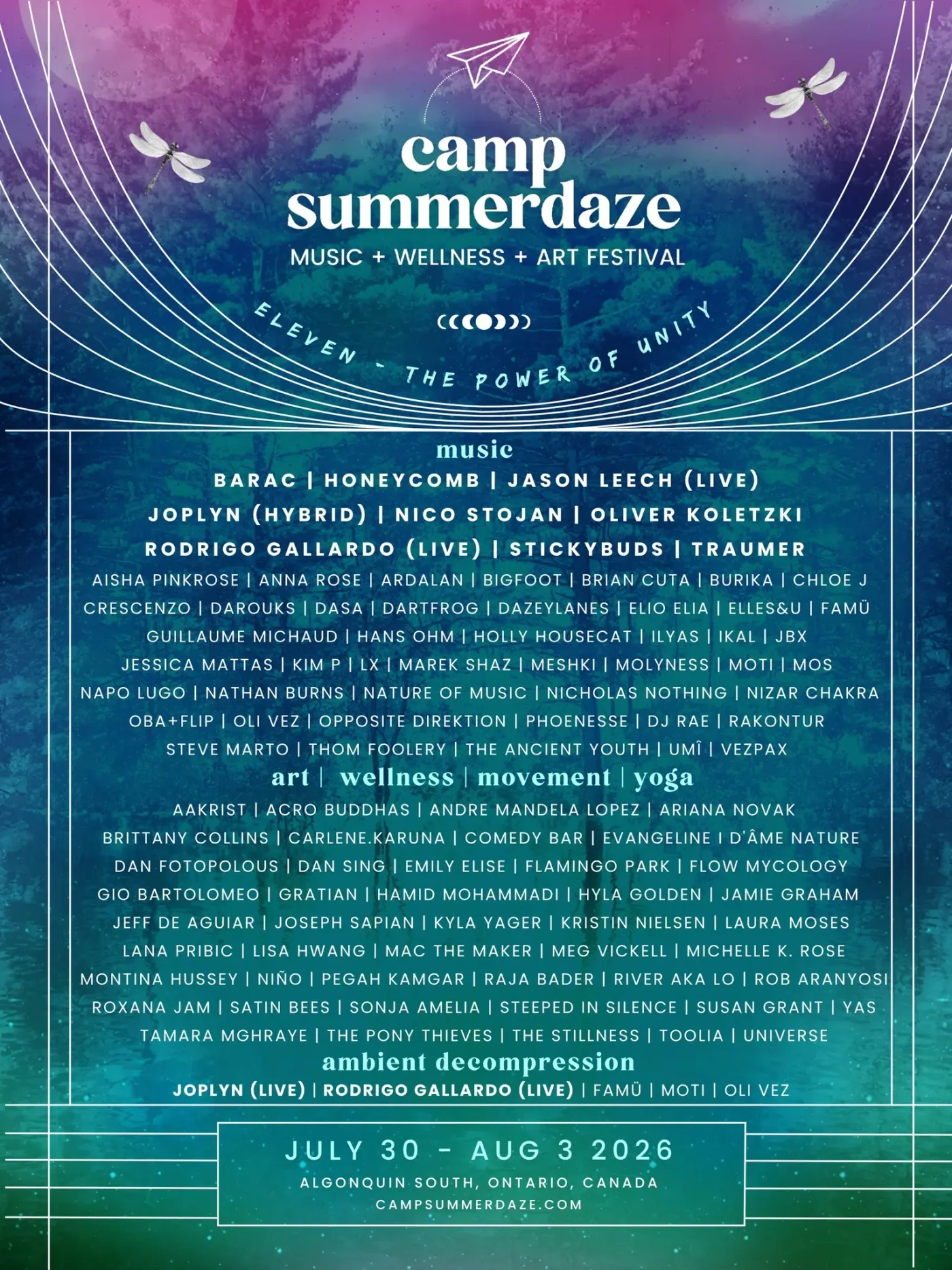
The July 30–August 3, 2026 edition pushed that structure further. Oliver Koletzki, Traumer, Joplyn, Rodrigo Gallardo, Honeycomb, Stickybuds, Ardalan and Nature of Music were among the artists spread across multiple music spaces, while facilitators led breathwork, art, cacao, movement and connection-focused sessions elsewhere on the property. The organisers called the year ELEVEN and framed it as the launch point into another decade. Whether that number is read as physical festival editions or the wider age of the community matters less than the intention behind it. Camp Summerdaze now speaks about itself less like an annual event and more like a continuing culture with its own shared memory.
The next gathering is confirmed for July 29–August 2, 2027 on the same Algonquin South land. Four nights of camping are built into the ticket because leaving each night would contradict what the festival has become. The experience continues after the final set, on the walk back through the trees, around food the next morning and in the rare quiet periods before another sound system begins. Summerdaze started because its founders missed Sunday daytime parties. More than a decade later, it has arrived somewhere they could not have reproduced on a Toronto rooftop: a forest home where the point is no longer to extend the party for a few extra hours, but to create a place people are reluctant to leave.
Timeline
One artist per year — highest ranked in our archive
Those who appear most across this franchise's editions.