Ranking
#1,255

Ranking
#1,255
When
22–JUL 25, 2027
Featured artists
Lineup coming — we'll publish it as soon as it's confirmed.
Time left
3 editions to explore · future, live and past
Numbers, home base and house quirks
Campo Sancho has preserved something many festivals lose as soon as they become successful: the sense that almost everybody could eventually share the same dance floor. At Walkern Hall there is no endless avenue of stages and no crowd large enough to turn people into anonymous dots. Camping sits nearby, woodland frames the music areas and families wandering around during the afternoon may reappear together beneath a Funktion-One system after dark. Scale matters because Campo Sancho comes from a culture in which the audience is not supposed to be a faceless mass in front of a performer. The party works when a DJ can read the room — or in this case the field — and when the people dancing feel that, for a few days, the place belongs collectively to them.
The story starts long before the first festival. Jim Angell, better known as Jimmy K-Tel, and Matt Brown launched Sancho Panza with a London warehouse party on New Year’s Eve 1992. Through the 1990s and 2000s they organised warehouse gatherings, boat parties and events inside film studios, old theatres and other improbable spaces, eventually establishing one of the defining house-music sound systems at Notting Hill Carnival. From 1994, their Middle Row position became a destination in its own right. The sound system mattered as much as the selectors, and a recurring community formed around it. For roughly twenty years, Sancho Panza learned how a dance floor could become a social institution rather than simply a place where music was being played.
When that Carnival chapter ended and many members of the crowd began raising children, Campo Sancho offered a way to continue without pretending everybody was still living the same life they had in the 1990s. The inaugural festival arrived in July 2016 in Hertfordshire with only around five hundred guests. Crazy P Soundsystem, Faze Action, The Revenge, Ray Mang and familiar Sancho selectors occupied two principal music spaces, while Panic Circus, workshops and children’s activities gave the daytime a different texture. A small wooden bridge linked sections of the site, fire pits appeared around the field and the outdoor Middle Row stage deliberately carried the name of Sancho Panza’s old Carnival street. It was continuity without reconstruction: the community had simply found a new landscape.
House and disco remained the centre, but Campo Sancho never treated genre loyalty as a reason to become narrow. Funk, soul, reggae, Balearic music, Afrobeat and live electronic acts have all passed through its programmes because groove and selection matter more than strict category. The sound itself receives almost obsessive attention. Sancho Panza’s relationship with Funktion-One began during its Carnival years and remains part of the festival’s physical identity. Middle Row acts as the daytime celebration, while Snare and Hi Hat becomes what the organisers describe as a warehouse party in a field after dark. Upwoods, introduced in 2025, sits in a woodland clearing and allows longer, looser sessions to develop away from the more direct energy of the other floors.
Family programming changes the rhythm without turning the festival into children’s entertainment. Panic Family Circus, crafts, Kids Factory, games, a teenager-focused clubhouse, yoga and Tai Chi occupy parts of the day. Later, the balance moves increasingly towards dancing. Many of the parents were not originally “family festival” customers at all: they met through Sancho Panza parties or spent years dancing at Middle Row before having children. Their children effectively inherited Campo Sancho. That history helps explain why the organisers speak so insistently about community. Some people on the field have known one another for decades. The difference is that campervans, family tents and young children now surround friendships that were originally formed in warehouses and on crowded West London streets.
Covid broke the sequence in 2020, and the 2021 return became one of Campo Sancho’s most emotionally charged editions. It landed on one of the first weekends after British restrictions had eased, and contemporary accounts describe the almost overwhelming feeling of hearing amplified dance music collectively again. DJ Paulette, Dicky Trisco, Norman Jay and Sancho Panza played for a crowd that needed little encouragement. Another edition followed in 2022, then the festival sat out 2023 before returning in 2024. That seventh gathering raised the musical profile significantly by booking Laurent Garnier for a rare festival appearance, yet the scale remained controlled. Council licensing documents still placed capacity around only 1,350 to 1,500 people.
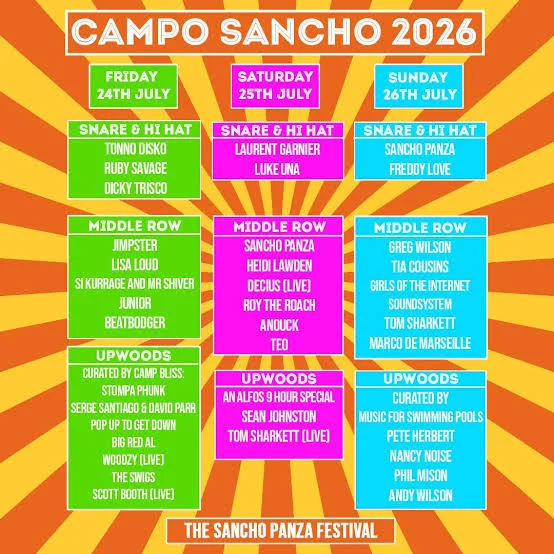
Upwoods arrived in 2025, giving Campo a third distinct musical environment. Optimo, Luke Una, Grace Sands, Aroop Roy, Crazy P DJs and returning residents reflected a booking philosophy that places respected veterans beside newer selectors rather than building everything around one giant headliner. The ninth completed edition, July 23–26, 2026, extended that approach. Laurent Garnier returned; Greg Wilson made his Campo debut; Jimpster, Ruby Savage, Tia Cousins, DECIUS, Girls of the Internet, Heidi Lawden and Luke Una appeared alongside a nine-hour A Love From Outer Space session and the persistent Sancho Panza family of DJs. The names had become more internationally significant than they were in 2016, but they still fitted inside three recognisable dance spaces.
No official 2027 date has been published yet, although Angell and Brown have already said they are thinking about it. That lack of urgency suits a festival that has never measured success by adding fields or pushing capacity towards five figures. Campo Sancho was built after decades of throwing parties precisely to recover what bigger events often dilute: exceptional sound, selectors who understand the context and a crowd small enough to recognise itself. Sancho Panza once filled a West London street with many thousands of dancers. In Hertfordshire, its founders chose the opposite direction. One of Campo’s most revealing scenes is therefore not a superstar behind the decks, but somebody who danced at Middle Row thirty years ago crossing the same small field today with their children beside them.
Timeline
One artist per year — highest ranked in our archive
Those who appear most across this franchise's editions.
 #1
#1France
1 editions · 2026
 #2
#2United Kingdom
1 editions · 2026
#3Sweden
1 editions · 2026