Ranking
#413

Ranking
#413
Followers
170.2 K
When
2027
Featured artists
Lineup coming — we'll publish it as soon as it's confirmed.
5 editions to explore · future, live and past
Numbers, home base and house quirks
For years, the most revealing CarFest sight was not a headline band or a pristine supercar sitting behind ropes. It was a racing machine moving along a private road on a Hampshire farm while families watched from the side, followed a few hours later by thousands of those same people singing in front of a pop stage. That improbable handover from engines to music explains the festival better than calling it either a motoring show or a music event. Chris Evans built CarFest around the idea of his ideal weekend — cars, food, music and family time — but attached one condition that eventually became more important than any single attraction: the weekend had to raise money for children’s charities.
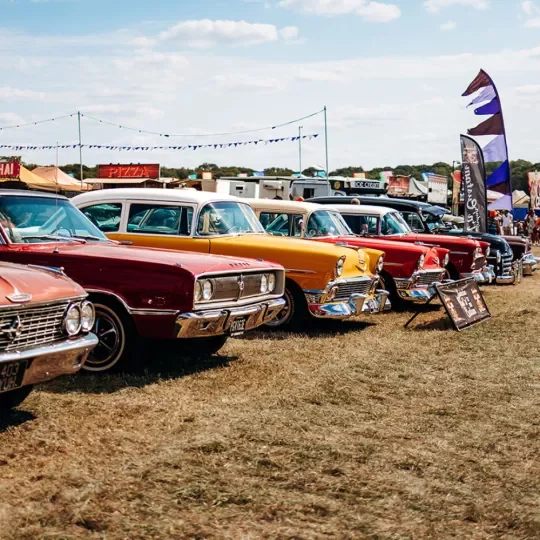
The concept became real in 2012 when former Formula One world champion Jody Scheckter offered Laverstoke Park Farm in Hampshire as the home of the first CarFest South. The event had been conceived only months earlier, yet it sold out and was followed shortly afterwards by CarFest North at Cholmondeley Castle. From the beginning, the car element was meant to move. Evans’ own collection, historic racers, unusual road cars and machinery from across motorsport were not simply lined up for inspection; track runs and demonstrations gave the site its soundtrack during the day. Around them sat food stalls, activities and live entertainment. It felt less like a carefully segmented trade show than a family fair where a Formula One car might happen to start up nearby.
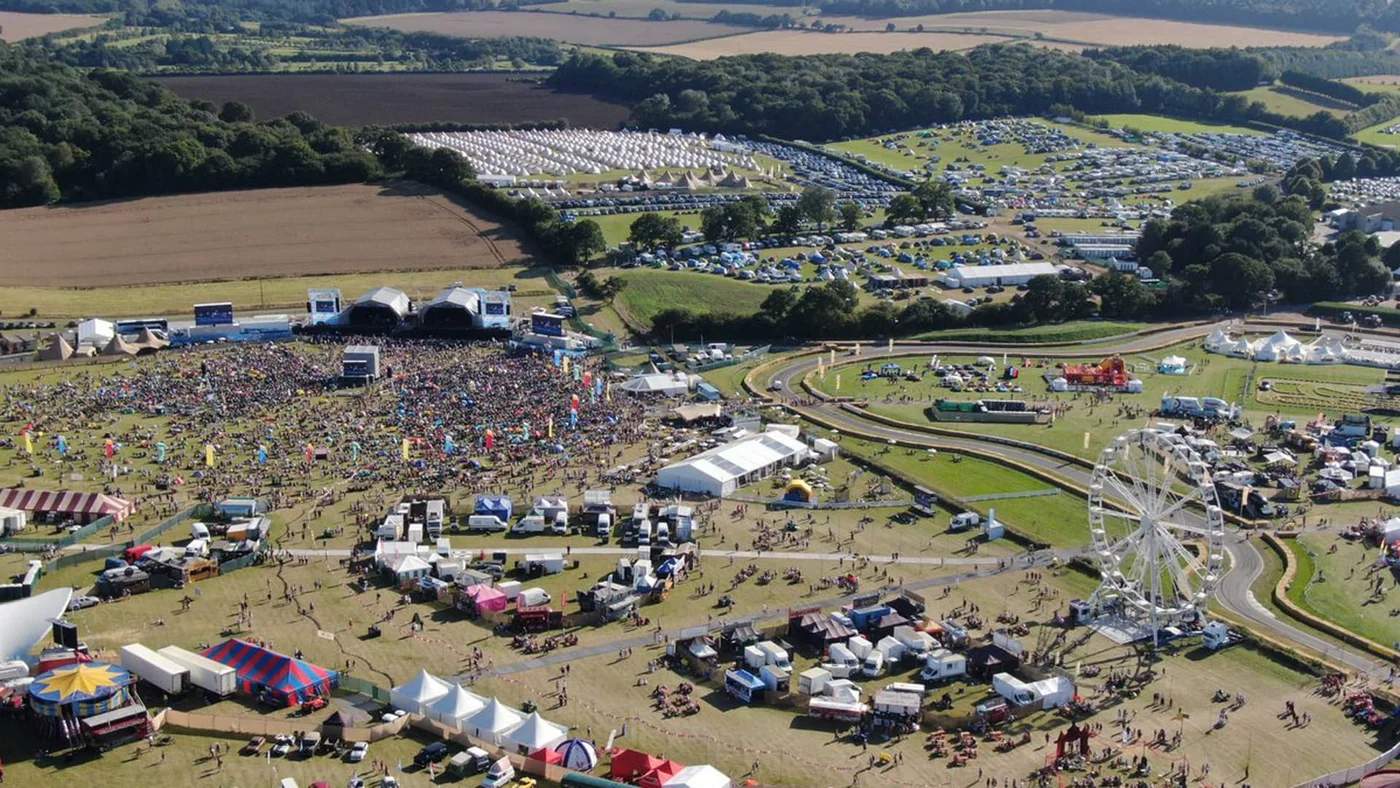
North and South developed as two regional versions of the same idea. The northern event moved between venues in Cheshire, including Oulton Park and later Bolesworth, while Laverstoke became the permanent southern home and eventually the emotional centre of CarFest. The farm shaped the festival in ways that were easy to overlook. A temporary track cut through fields containing paddocks, car clubs and family attractions; camping kept people on site; a large music stage took over as the engines quietened in the evening. In 2015, Jody Scheckter could drive machinery from his own racing history while Take That and Paloma Faith performed later in the weekend. Those combinations would be absurd at most events. At CarFest, the lack of stylistic purity was precisely the organising principle.
Music gradually became substantial enough to stand on its own without ever taking control of the whole festival. Take That, Stereophonics, The Jacksons, Kaiser Chiefs, Paloma Faith, Culture Club, Rag’n’Bone Man and Rick Astley are among the artists who have appeared over the years. The bookings tend to make sense across generations rather than within a tightly defined scene: familiar British pop, rock, soul and singalong acts capable of gathering parents, teenagers and children after a day in which each may have been interested in something entirely different. Meanwhile, the daytime programme expanded. Celebrity chefs were given demonstration stages, children’s entertainment grew into a major strand, wellness and nostalgia gained dedicated areas, and comedians, broadcasters, athletes and television personalities became part of the programme.
Eventually CarFest began describing itself almost as several festivals occupying the same site. KidsFest could contain a day’s worth of family entertainment; FoodFest revolved around chefs and cooking; SpaFest offered yoga, health and wellbeing; RetroFest looked backwards through popular culture; StarFest brought comedy and familiar faces from stage and screen; cars remained a world of their own. That structure made the weekend unusually tolerant of different attention spans. One member of a family could spend an hour around racing cars while another watched a cooking demonstration, then everyone could regroup for the main-stage music. Camping reinforced that rhythm because there was no need to consume every attraction continuously. CarFest was designed less around fear of missing out than around the assumption that nobody in one family would want exactly the same festival.
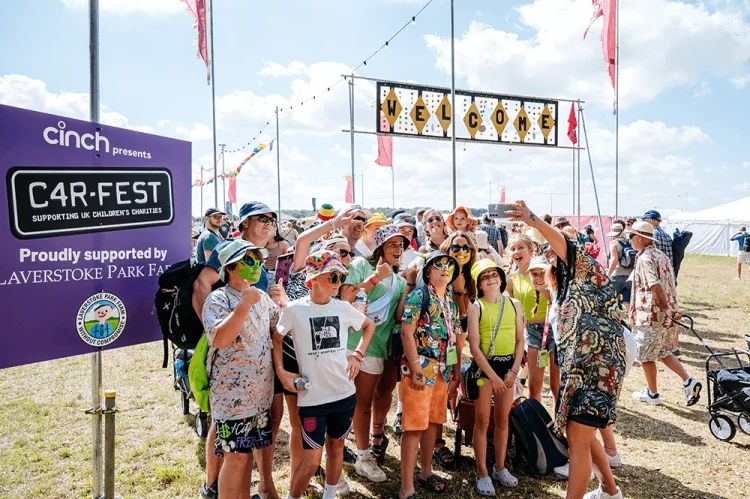
Charity is what has prevented that abundance from becoming merely a lifestyle fair. The event began in support of BBC Children in Need and gradually widened its beneficiary network, raising more than £27 million for UK charities since 2012. The organisations themselves became visible participants rather than names printed beneath a sponsor logo, and fundraising was woven through ticket income, auctions and on-site activity. For 2026, ten per cent of every ticket and all CarFest profits are committed to charity. That creates an unusual relationship with spectacle: the expensive cars, celebrity guests and major music acts are entertainment, but they are also tools designed to make the fundraising machine larger. Evans’ continued presence as host has helped hold that purpose together even as the programme spread far beyond his original three interests.
The route through the pandemic and its aftermath changed the festival’s structure. In 2020 there were plans to combine North and South into CarFest United before the event was ultimately cancelled. The two regional festivals returned, but CarFest North held its final edition in 2022. From 2023 the event concentrated on Laverstoke, becoming one large annual gathering rather than a northern and southern pair. Its last weekend at the farm came in August 2025. Travis, Rita Ora and Madness headed the three nights, with Busted, Squeeze, Tom Walker, Kim Wilde, The Boomtown Rats, Lightning Seeds and Seasick Steve among the supporting acts. It was both a normal CarFest weekend and an ending: after fourteen years, the fields and private road that had taught the festival how to work were being left behind.
On 28–30 August 2026, CarFest will make its first move to Silverstone Circuit. The shift is almost comically logical. A festival that once had to construct a temporary motorsport course inside a farm is relocating to the home of the British Grand Prix. Silverstone gives it permanent track infrastructure, larger grounds, better transport possibilities and room for far more automotive activity. The announced music includes Tom Jones, Jessie J, Nile Rodgers & CHIC, Sugababes, Rick Astley, Sophie Ellis-Bextor, Gabrielle and The Proclaimers, while the daytime programme is expected to bring the established CarFest worlds into a venue purpose-built for large audiences and moving machinery.
What Silverstone cannot automatically supply is the peculiar informality that Laverstoke gave CarFest for free. A racing circuit already knows how to look impressive; a farm hosting Formula One cars, chefs, children’s theatre and a major pop concert was inherently strange. The next phase will therefore test what the festival’s identity actually depends on. If it rests only on the place, something has been lost. If it rests on families moving between unrelated passions, ending the day together in front of a stage and knowing that the entire weekend is designed to fund charitable work, Silverstone may simply give that idea more room. CarFest began by turning a farm into something it was never meant to be. Its next challenge is to make one of Britain’s most famous circuits feel unusually relaxed.
Timeline
One artist per year — highest ranked in our archive
Those who appear most across this franchise's editions.
 #1
#1United Kingdom
1 editions · 2023
 #2
#2United Kingdom
1 editions · 2023
 #3
#3United Kingdom
1 editions · 2023
Documented photos from the franchise.