Ranking
#405

Ranking
#405
Followers
176.1 K
When
23–JUN 26, 2027
Featured artists
Lineup coming — we'll publish it as soon as it's confirmed.
Time left
12 editions to explore · future, live and past
Numbers, home base and house quirks
Some places seem to have been waiting for a particular festival long before the festival exists. Refshaleøen is one of them. Copenhagen's former industrial and shipyard district, with steel structures, concrete, warehouses and a working-class history beside the harbour, already possessed the kind of atmosphere heavy music normally has to manufacture through production design. When Copenhell arrived there in June 2010, it did not feel as though a random field on the edge of a capital had been given a metal makeover. The amplifiers, smoke, flames and distorted guitars seemed to belong naturally among the remains of industry. Only a few kilometres from central Copenhagen but isolated enough for very loud music, Refshaleøen became a temporary summer hell that would eventually grow into one of Scandinavia's defining heavy-music environments.
The first edition lasted only two days, June 11 and 12, 2010, and presented sixteen bands across two stages. Megadeth was among the major names, alongside Deftones, Napalm Death, Behemoth, Hatebreed, Suicidal Tendencies, The Dillinger Escape Plan, Mnemic and others representing several generations of metal, hardcore and extreme music. The original intention was straightforward: Denmark needed a festival that did not treat heavy music as one specialised corner of a broader rock programme, but went deeply into the culture itself. Copenhell grew from that principle. More stages appeared, the weekend became longer, and the musical range expanded from traditional heavy metal into thrash, death, black, doom, hardcore, metalcore, industrial music and hard rock. Metallica, Slayer, Judas Priest, Iron Maiden, Scorpions, Alice Cooper, Slipknot, Tool, Avenged Sevenfold and many others eventually passed through Refshaleøen, while Danish bands gained a national platform inside a festival designed to treat their scene as something important rather than peripheral.
Copenhell also discovered quickly that its community wanted more than a timetable of concerts. Helvíti, Hades, Pandæmonium and Gehenna became familiar stage names, while the Biergarten developed a culture almost independent of the main arena, built around live metal karaoke, DJs, quizzes, communal anthems and the famously chaotic Power Hour. Elsewhere there have been Viking battles, wrestling, corpse-paint stations, bizarre games, tattoos, theatre, dark markets and activities that take metal imagery seriously enough to understand how funny it can be. Copenhell Con widened that parallel universe into gaming, horror, fantasy, comics, film, panel discussions and artist interviews. The festival can therefore treat an exceptionally technical guitar performance with complete seriousness and then invite thousands of people to scream a familiar chorus together in a beer tent. That balance between intensity, black humour and friendliness has become just as central to the experience as the headliners.
The growth in audience has been equally striking. From the comparatively compact first year, Copenhell moved through three-day formats and eventually into four full days, while the infrastructure across Refshaleøen became progressively more sophisticated. The pandemic cancelled the 2020 and 2021 editions, but the 2022 return opened a larger phase of the festival's history. Throughout that expansion, Copenhell has increasingly presented rock and metal culture as a space built on mutual respect and shared enthusiasm rather than exclusion. The crowd now stretches far beyond veteran fans in classic band shirts. Teenagers arrive for metalcore and new extreme bands, alternative audiences follow experimental or industrial acts, and many people discover the festival before they have any deep connection with traditional metal culture. In 2026, roughly a quarter of the audience was expected to be attending Copenhell for the first time, a significant indication of how widely its appeal had expanded.
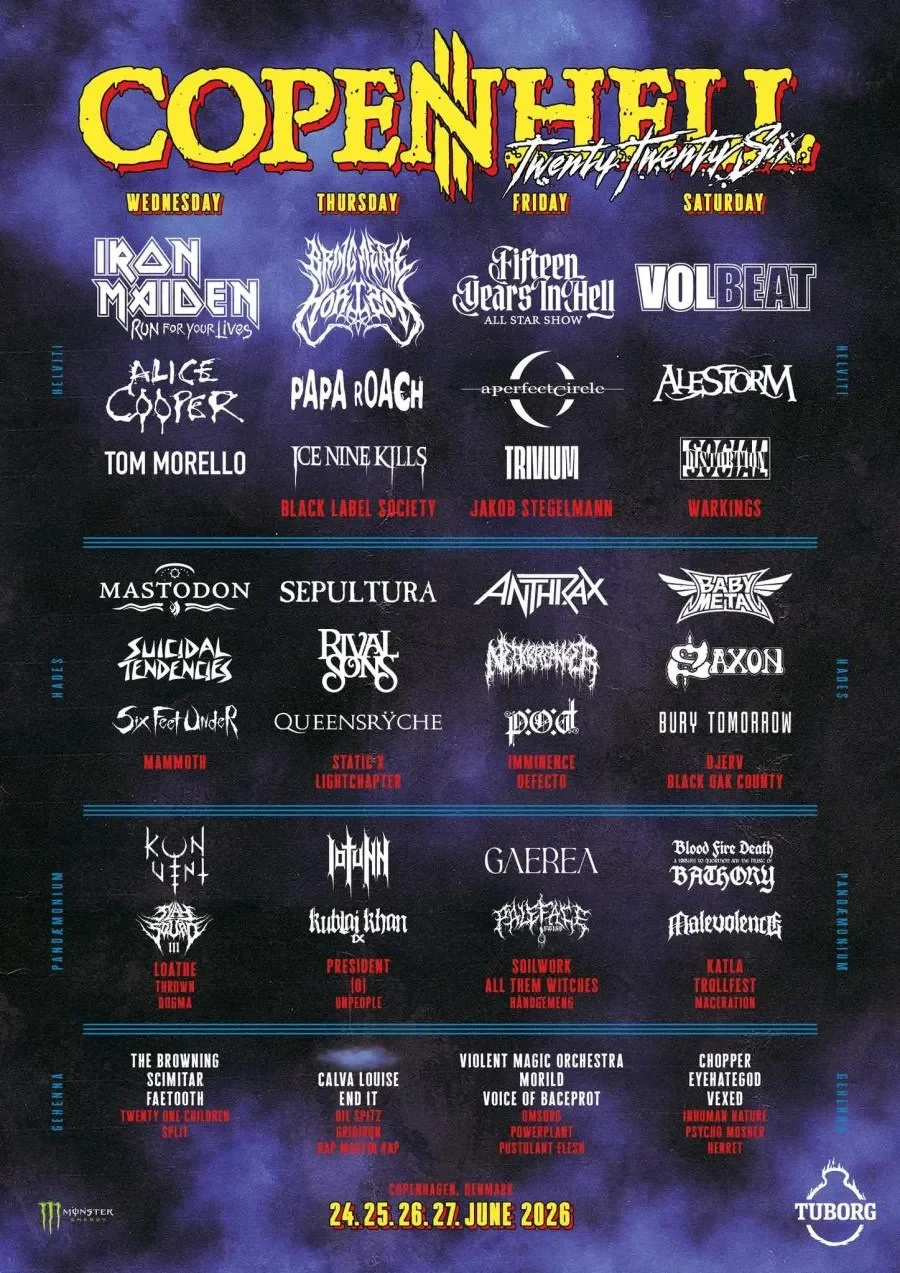
The fifteenth edition, held from June 24 to 27, 2026, demonstrated the scale of that transformation. Every ticket category sold out and the festival expected around 39,000 people per day, setting a new attendance record. Iron Maiden headlined Wednesday, Bring Me The Horizon Thursday, Twisted Sister Friday and Volbeat Saturday, creating a remarkably neat cross-section of what Copenhell had become: foundational British heavy metal, one of the defining forces in modern heavy music, flamboyant hard-rock history and Denmark's biggest contemporary heavy-rock export. Around them were Alice Cooper, Anthrax, Sepultura, A Perfect Circle, Trivium, Papa Roach, Babymetal, Black Label Society, Suicidal Tendencies, Tom Morello, Mastodon, Soilwork, Konvent, Gaerea, Ice Nine Kills and many others. The anniversary also produced “HellWalkers”, a festival song created by musicians from different corners of Denmark's heavy scene, and a large all-star performance involving dozens of Danish artists across generations.
Copenhell is already scheduled to return from June 23 to 26, 2027, yet its importance is difficult to measure through future headliners alone. Across fifteen editions it has built something much more durable: a community with its own rituals, stage names that feel like neighbourhoods, areas where the party continues long after the biggest bands finish, and a relationship with Refshaleøen strong enough that the festival now seems inseparable from the old industrial landscape. At night, the shipyard structures disappear into flame, light and tens of thousands of black shirts; classic heavy metal can be roaring from one direction while death metal, hardcore or dark electronic sounds emerge from another. Central Copenhagen remains close enough to reach by bicycle, but for four days the island feels like a different city entirely. That temporary city has a deliberately uncomplicated name: Copenhell.
Timeline
One artist per year — highest ranked in our archive
Those who appear most across this franchise's editions.
 #1
#1United States
2 editions · 2023–2026
 #2
#2Portugal
2 editions · 2023–2026
#3Denmark
2 editions · 2023–2026