Ranking
#1,255

Ranking
#1,255
1 editions to explore · future, live and past
Numbers, home base and house quirks
There is a point on the approach to Dauphin’s Countryfest when it becomes obvious that camping is not merely an optional service attached to the festival. About ten kilometres south of Dauphin, Manitoba roads begin filling with pickups, trailers and RVs heading towards Selo Ukraina, and the rural landscape gradually turns into a temporary town of awnings, flags, barbecues and neighbours who will share the same patch of ground for four days. The amphitheatre sits beyond it all, part of a site that has spent decades learning how to accommodate thousands of country fans. For many regulars, Countryfest does not begin with the first headliner. It begins when camp is built.
The festival itself started for an unusually practical reason. In the late 1980s, Selo Ukraina needed additional revenue to help sustain a cultural site created around the Ukrainian-Canadian heritage of the region. Local businesspeople developed the idea of a country music festival that could generate that income, and the first actual event took place in 1990. Ricky Skaggs, Nitty Gritty Dirt Band, George Fox, Prairie Oyster, The Good Brothers and others played that inaugural year. Success was not immediate. The early editions struggled financially, community loans were required, and only after several years did the event reach a position where debts could be repaid and money reinvested in the grounds.
That history helps explain why Dauphin’s Countryfest has never operated exactly like a touring festival brand temporarily occupying a small city. The organisation became community-based and not-for-profit, and its relationship with the Dauphin region deepened as it grew. Countryfest has supported recreational facilities, community infrastructure, walking trails, local projects and scholarships. The economic impact of tens of thousands of festival visits matters enormously, but the relationship also works in the other direction: some of what the event generates is returned to the community that has kept it alive.
The modern scale would be difficult to recognise from photographs of the earliest years. Selo Ukraina has developed multiple campgrounds, service areas, VIP facilities, vending zones, secondary stages and a substantial amphitheatre. At peak periods, attendance has been reported around fourteen thousand people per day, with more than four thousand campsites. RVs and tents remain in place throughout the weekend, while showers, treated water, waste collection and shuttles make the grounds function like a small rural settlement. The campsite is therefore not waiting space between concerts. It is one of the festival’s principal neighbourhoods.
The amphitheatre remains the emotional centre. Over the decades it has hosted virtually every generation of mainstream North American country. Waylon Jennings, Vince Gill, Toby Keith, Tim McGraw, Faith Hill, Kenny Rogers, Clint Black, Alan Jackson, Reba McEntire, Keith Urban, Carrie Underwood, Blake Shelton, Miranda Lambert, Eric Church, Luke Bryan and Jason Aldean all belong to the festival’s history. Canadian country has been equally important: Terri Clark, Paul Brandt, Michelle Wright, Prairie Oyster, Charlie Major and many others have ensured that the event never became simply a Manitoba stop for Nashville touring packages.
Musically, the edges have always been more flexible than the name might suggest. Traditional country, honky-tonk, contemporary radio country, Americana and country rock sit at the centre, but roots, folk, blues and straightforward rock have repeatedly entered the programme. Secondary stages make that breadth easier to explore, offering regional artists, open-mic activity and sets that would feel very different on the main amphitheatre stage. Tribute acts and Canadian rock bands have also become familiar additions. Somebody can arrive with a carefully planned list of country performers and still discover that their favourite moment happened at a smaller stage hours before the headliner.
Campground culture supplies many of the stories the poster cannot show. There are decorated campsites, line-dancing sessions, games, food, contests and informal social traditions that have accumulated across generations. Countryfest also carries details that root it firmly in Manitoba: perogies and Ukrainian cultural references remain part of the Selo Ukraina environment, Indigenous performers appear alongside country acts, and local musicians can share a weekend with artists whose records dominate North American radio. Move the same lineup to a generic field and the concerts might still work, but the festival would lose a substantial part of its personality.
COVID created the first sustained interruption since the 1990 launch. There was no normal festival in either 2020 or 2021. When Countryfest finally returned in 2022, organisers built an all-Canadian lineup, supporting a national music industry that had just endured two exceptionally difficult touring years. The annual rhythm resumed from there, with international stars once again sharing the weekend with Canadian veterans, regional performers and emerging artists.
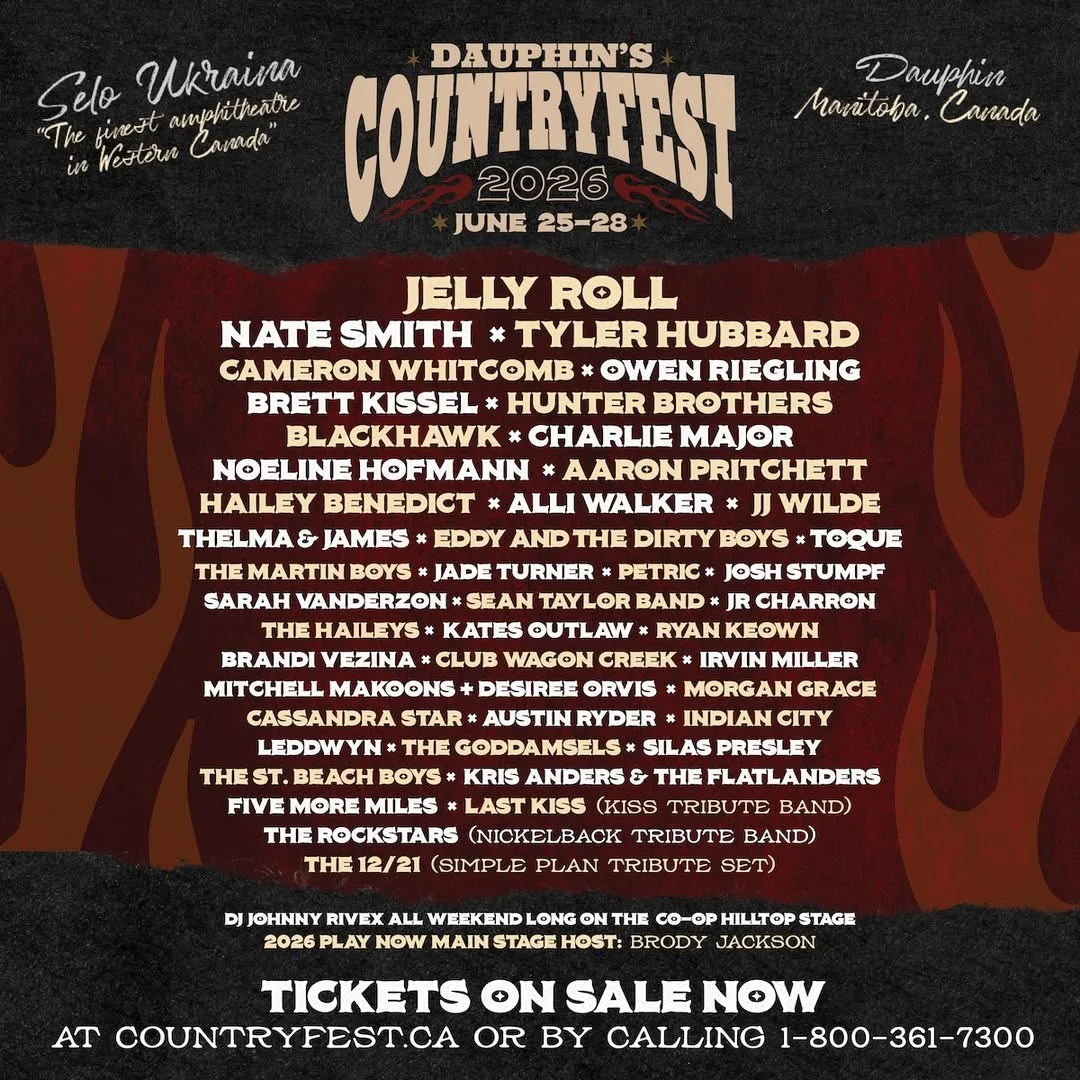
The 2026 edition ran June 25–28. Tyler Hubbard led Friday, Jelly Roll Saturday and Nate Smith Sunday, while Cameron Whitcomb, Brett Kissel, BlackHawk, Hunter Brothers, Charlie Major, Owen Riegling, Noeline Hofmann, Aaron Pritchett, Hailey Benedict, Alli Walker, JJ Wilde, Indian City and dozens of others filled out the weekend. The programme moved naturally between contemporary mainstream country, Canadian country, 1990s references, roots music and rock. That range says something about the audience: after more than three decades, Countryfest is serving several generations rather than one narrowly defined demographic.
Official dates for the 2027 festival have not yet been published, although Countryfest is already giving away 2027 passes through on-site competitions. Continuation therefore appears clear even while the calendar remains TBA. More important than another date, however, is what happened to the original idea. A festival created to help sustain a cultural site ended up turning that site into one of Canada’s major country-music destinations. Every summer, trailers once again roll down the highway south of Dauphin, campsites fill, the amphitheatre lights come on, and Selo Ukraina becomes a place people return to not only for whoever is headlining, but because the weekend itself has become the tradition.
Timeline
One artist per year — highest ranked in our archive
Those who appear most across this franchise's editions.
 #1
#11 editions · 2026
 #2
#21 editions · 2026
 #3
#3United Kingdom
1 editions · 2026